
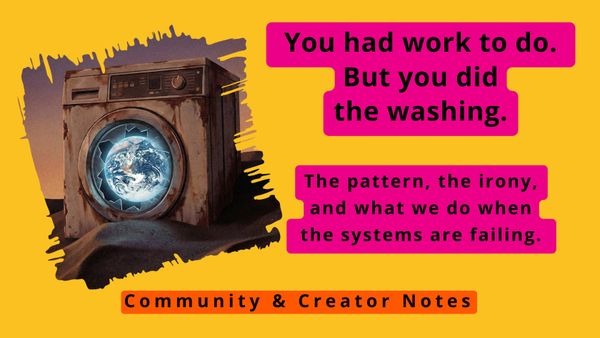
You had work to do, but you did the washing
The pattern, the irony, and what we do when the systems are failing.

So Reader,
I was supposed to send an email. Business-critical, as they say. Inviting the last 50 people to the London Coworking Assembly Forum on the 24th February.
It was 4 o’clock in the afternoon. My concentration was doing battle with the work. I had a list in front of me. I said, “I will do this email, then I will do the washing, and then I will come back and continue with this other article.”
I went into the kitchen. Before I knew it, I was unloading the washing machine.
I stopped. Went back to my computer. Absolutely amazed that I hadn’t kept to the list I’d just written—even though I knew the reason I was doing the washing was that the work I was supposed to do was mentally challenging.
It was raining heavily outside. Our flat is on the third floor. Big windows. You can see the rain. The building is always warm—no heating, but always warm. I felt cosy and protected inside.
This only happens when the work is hard. Easy work? No washing. Hard work? Suddenly, I’m the washing champion of Vigo. Probably the main reason I’m still married.
The Pattern
Last month, I discovered the AI analysis feature in 750words—the platform I’ve used since 2013 to write 750 words every morning. They call it “Reporting,” and it showed me something I wasn’t ready to see.
A clear line in the sand. Before diagnosis: flapping about like a fish out of water. After diagnosis: medication stabilisation, a month of finding the right dosage. Then everything clicked.
But there’s grief in that clarity. Realising that huge chunks of your life have been spent coping with ADHD and masking. Even now, with medication, with self-awareness, I still find myself loading the washing machine when I should be doing business-critical work.
I have a Pomodoro timer on one of my screens—a big, annoying countdown clock. If I don’t, I’ll start researching what type of car tyres were on David Bowie’s tour bus for the Serious Moonlight Tour in Australia in 1983. That’s where my brain goes.
Undoing years of habit compounding. Re-learning how to function.
The Irony
But while I was hanging the washing, I remembered something Melissa Richards, the owner of Buick Mackane coworking, posted about working from home and doing the washing instead of work. That pull toward domestic tasks when the “real work” gets scary.
And then I thought about Hans Rosling.
Back in 2010, when TED was still cool, Hans Rosling gave a talk about washing machines. He said they were magic. They gave his mother time to think. Freed her from manual labour so she could read books to him. Survival became culture.
The washing machine gave women time.
And here I am, in 2026, using mine to avoid thinking.
The irony is brutal. First-world people get distracted from their work by the washing. Meanwhile, billions of women around the world are still washing by hand.
Rosling said it: “It’s a hard, time-consuming labour which they have to do for hours every week.”
That IS the work, not the distraction from it.
It’s a class thing, hidden in plain sight.
What Social Media Gave and Took
I owe everything to social media. I joined Twitter and Meetup in the summer of 2008. Before that, Ecademy and LinkedIn in 2006. My strongest relationships today came from those connections.
My career came from them. I discovered TED through them. Hans Rosling. Paul Jarvis and Company of One—a book the 750words AI recommended last week that I’d completely forgotten I owned. It shaped everything I do.
But from 2016, something shifted. Brexit. Trump. Cambridge Analytica. The algorithm is optimised for rage, not connection. The relationship between government, big tech, and political power became appalling. People are slowly realising this is the milk turning sour in the Consumer Story.
When I analyse my 750words from last summer, I can see the intensity. Gaza. UK politics. Even when I wasn’t logged in, it dominated my thoughts. Even with app blockers and screen timers, I’d “wake up” an hour later in the kitchen, scrolling.
I left Instagram in January. Ewan Buck from Contingent Works told me he stopped using Instagram after starting Talk Club. That was my permission slip. I knocked social media on the head at the beginning of January.
My mental health is significantly better now.
Bernie’s Picks: What We’re Building
We’re ten days out from the Forum. I’m sharing these five things again because they’re the curriculum for what we’re building. Whether you come on the 24th or not, try one of these. They’re already happening.
Way 1: Start a Talk Club
Talk Club is a club for men to talk and listen. No app, no complex onboarding. Just a time, a space, and a format that lets people say what they’re experiencing. Ewan hosts one at Contingent Works. He’ll be at the Forum on the 24th—ask him how it changed his community. Talk Club Website
Way 2: Host an ACTionism Screening
Jon Alexander’s ACTionism documentary starts a conversation about ownership and agency you can’t fake. You don’t need a cinema. You need a wall, a screen, and chairs. Urban MBA showed it. Village halls are showing it. Coworking spaces like Patch and Dragon Coworking are showing it. Request a screening
Way 3: Run a Creator Write Club
For a decade, we ran these every week across London. Around one table: a journalist next to a poet, a musician next to a sailor. State your intention, write in silence for two hours, and share what you made. It works anywhere from a village hall to a Zone 1 cafe. All it costs is a table and the willingness to show up.
Way 4: Host a Pop-Up Coworking Event
In all my years in coworking, I always recommended people start with a pop-up before they buy a building. You don’t need a permanent space to prove the community exists. I’m part of the coworking pop-ups here in Vigo. One place we go to has painters at their easels and our group on laptops. It’s chaotic and perfect.
Way 5: Join European Coworking Day (May 6th)
This is the day all the other ways come together. It’s run by Coworking Switzerland as part of the wider European Coworking Assembly —a network that includes the London Coworking Assembly and the European Rural Coworking Project. This is the moment for independent spaces to be seen and counted. You don’t need a huge budget. A Talk Club, a pop-up, an open door—any of the ways listed above can be your contribution. Register your space today
February 24th at Blue Garage
Some people have said the event page for the 24th is doom-and-gloom. But they’re writing event copy like it’s 2014, avoiding the actual problems.
Yeah, it’s heavy. Because it IS heavy.
We all have a ringside seat to the collapse of society. I’m having a smoother ride here in Vigo, gazing out onto the Atlantic Ocean. But many of my friends and family in London are on the verge of burnout, running their businesses, crushed by the cost-of-living crisis.
Coworking is not flat whites, cool furniture, rooftop bars, and white men in Patagonia vests.
Coworking is the engine room of a new invisible working class. Beneath the laptop stickers, these are people fighting the same old battle: no guaranteed income, no sick pay, one bad month away from trouble. They’re gathering to build their own safety net because the old one is gone.
That’s why we’re running the event at BLUE GARAGE 💙 —a smacked-up 70s building by a roundabout in Lewisham, not a glass tower in Bishopsgate. Every coworking industry event takes place in Zone 1 and draws everyone from the suburbs. We’re going where the people are. South of the river. (Difficult for North Londoners, but that’s the point.)
People keep asking me, “What am I going to get out of the 24th?”
You’re going to sit in dialogue with people at their own coalface. People owning spaces, running spaces, building community in their neighbourhoods, trying to stabilise the local economy as well as their own households. People from local councils who want to connect with real partners already in the buildings.
We’re not getting a seat at the table. We’re building the table.
Showing up in that room means you can start making a difference and building momentum in your life, your neighbourhood, and your space. That’s worth more than however many likes you give Greta Thunberg or on Instagram. (You should still support them, though—they’re cool.)
This work is already in motion. While I think coworking is an action, the neighbourhood workspace is where my heart is.
Thank you for your time and attention.
Bernie 💚🍉
P.S. Every time you obsess over an open rate, you’re working for the software company. Every time you show up in a room with people doing the work, you’re working for your community.
Choose who you work for. Get your ticket to 24th Feb here.