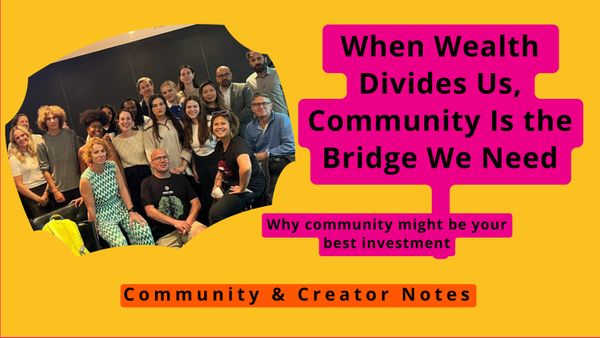
When Wealth Divides Us, Community Is the Bridge We Need
Why community might be your best investment.
So Reader,
My inbox got noisy after my podcast with Kofi Oppong about wealth inequality.
We hit a nerve.
The gap isn't just numbers—it's changing how we live, work, and even date.
In a separate post, I saw Tom Ball from DeskLodge | B Corp™ share:
Times are tough for a lot of people. When people spend less often, they expect more. People are going out less, so it would be better if they did.
Tom points out that it's the same for coworking spaces and offices.
Working twice a week in the office means those days need to matter.
They need to feel alive, social, and human.
✋ Mind the Wealth Gap: Why Entrepreneurship Isn't Optional with Kofi Oppong
We're Built to Create, Not Just Consume
Citizenship is making a comeback - I don't know where it went - but it's back.
People are tired of just consuming and hungry to build something real.
Josh Johnson puts it clearly:
"If your obsessions are community, culture, connection, and compassion, there's a way forward."
And Kofi made it urgent:
"This isn't about building a unicorn—it's about staying alive."
Entrepreneurship isn't a TED talk.
For working-class communities, it's a lifeline.
No romantic stories, just dodging eviction, feeding families, surviving.
Same Tools, Different Starting Lines
What bothers me is that people still pretend anyone with Wi-Fi and a laptop can build a business overnight.
I have those same tools—and I got lucky.
Lucky to sit next to smarter people in coworking spaces and see their highs and lows.
I was lucky to bump into Kofi Oppong at a 2019 event we were both part of in a coworking space in Hackney.
Fifteen years ago, I was lucky to find my now business partner, Emily Breder, in a LinkedIn group for Event Managers started by Julius Solaris.
I was lucky to connect with many of you on Twitter circa 2010 when it meant something.
But even with all that luck?
I still ebb and flow and fucking struggle between the highs.
After you have made it, you can easily turn 10 years of hustle and burnout and piecing it together into some cheap Instagram slogan about "Wi-Fi and a dream."
But here's what happens:
- First, figure out how to buy a laptop.
- Next, work out what the hell to do with it.
- Then, drown in YouTube videos selling magic shortcuts that lead nowhere.
- And like Aceil Haddad - pointed out here - not everyone, including me, identifies with the term entrepreneur.
Building a business or being more entrepreneurial isn't a button you click if you've just left teaching, nursing, kitchens, road-sweeping, or driving a bus.
As Gary Stevenson says, I'm tired of people pretending it is.
The "New Dork" Myth: Still Funny, Still Bullshit
About 15 years ago, this video came out, parodying social media and online hustle culture.
It mocked the Silicon Valley hype and ended with:
"You can build a business doing what you love."
Sound familiar?
That line became WeWork's slogan—until they crashed spectacularly.
If only the coworking industry had spent the same amount of time talking about the wealth gap in London as they talked about how many times they've met Adam Newman and what WeWork did for the industry.
Written by