So Reader,
Before we go any further: if you're a coworking space owner or community manager, Unreasonable Connection is happening at Space4 in Finsbury Park on May 19th, 09:30–15:30.
It's the next London Coworking Assembly Forum — a day of working in small groups with other operators who understand what you're carrying.
Produced in collaboration with Urban MBA and Tilley Harris at Akuo and. £150. Get your ticket here.
For a long time, The Sopranos was my all-time favourite TV show.
Then I found Better Things. I came to it late — all five seasons had already run. I watched the whole thing and it quietly took the top spot.
There's a scene in the final season where Duke — Pamela Adlon's youngest daughter — sits outside an antique shop, glued to her phone, vaping.
An older man steps outside, watches her, then says: "The robots have got you."
The episode is called Ephemera. Physical things. Memorabilia meant to be temporary but preserved through time.
Duke is sitting outside a building full of postcards, ticket stubs, vintage clothes, photographs — and she won't go in. She's staring at the blue light of her screen instead.
Pamela Adlon's friends run the antique shop — she filmed the whole scene there.
She said the whole episode was about Duke moving from a little girl to a young adult — and that scene is the signal. The magic child who could see ghosts, who felt the energy of the past, is gone. The phone took her somewhere else.
The vaping says it too. We used to roll cigarettes — there was something physical in it, something you made with your hands.
Now it's a machine. A cartridge. You inhale a chemical from a device and scroll.
Two losses of the physical in one bench.
Ever since I listened to Pamela Adlon talking about this scene in a podcast in 2023, I've been thinking about it.
Because it's not just Duke.
Power cut. April 2025, Vigo. 11am.
The power went out.
Not a flicker. Everything stopped.
Podcasting, blogging, article writing, how I connect with clients, how I pay bills, how I buy things — all of it. Just gone. The whole Iberian Peninsula had gone dark.
I sat there in the flat and realised: every single thing I do is electronic.
Every single thing.
I knew this, of course. But until you're actually in it — standing in our street on a blazing Tuesday morning, watching everyone mill around trying to get a signal, nobody sure what to do next — you don't feel the weight of it.
Technology doesn't arrive as a revolution. It creeps.
It takes one thing, then another, then another, until the day you look up and you are entirely dependent on infrastructure you don't control and barely understand.
When I worked in restaurants, a power cut meant candles on the tables. We cooked on gas. Orders went on paper pads, not electronic screens.
People paid in cash, or by cheque, or with a credit card — and a credit card meant a manual imprinter, a physical machine that pressed the card details onto paper.
Nothing needed electricity. The place kept going. Customers stayed. Sometimes the food was better.
Now? Everything is electric. Everything is online.
The robots haven't just got Duke. They've got me.
Disconnecting vs. living disconnected
Living disconnected is what Duke is doing on that bench.
She's not present to the antique shop, the old man, the street, the afternoon. She's elsewhere. Scrolling.
When I wasn't doing well mentally, I'd do the same — black out scrolling for way longer than I knew was a good idea. Just letting the machine feed me in whatever order it came.
Chickpea recipes. Drone massacres.
AI productivity hacks. Genocide.
Coworking trends. Political corruption.
You just sit there and take it all in, one swipe at a time, completely disconnected from the room you're actually in.
It felt productive. I was disconnecting from myself and from everyone around me.
I stopped using social media in December. My brain is clearer. I still get stressed and anxious.
But the daily bombardment is gone, and I can read a few pages of a book again.
With dyslexia and ADHD, that's not nothing. My brain isn't being constantly hammered by an endless feed of the world's most devastating and most trivial things all at once.
The fog has lifted a bit. Not gone. But lighter.
Now I walk around Vigo, and I'm actually there.
At the end of our road there's a hill. I walk up it nearly every day.
At the top: ruins of a medieval fort. On one side, you look inland — valleys, green hills. On the other, out to sea — the town across the bay, the Atlantic beyond it.
Dock cranes half a mile away, cranking and dropping containers onto ships. The sound echoes all the way up.
On still mornings there's a haze in the air, mist over the water. You can hear the stillness.
I use the VoiceNotes app to walk and talk — still being connected to a robot, yes. But I can hear things. I can hear the wind.
I come down through the old town deliberately, to remind myself of the history here.
I like having my headphones out because it helps me hear the sunshine.
Disconnecting is that.
Living disconnected is staring at a screen so you can post a photo of the walk instead of being on it.
Scott Heiferman, the Meetup founder, said we should use the internet to get off the internet.
He built a platform to help people come together in their neighbourhoods around shared interests. Meetup always found it hard to make money and get investment.
Every extractive platform that sucks people in is worth billions. The one thing that actually helped people meet each other couldn't flourish at the scale it deserved.
The headlines talk about billions. The operators talk about keeping the lights on.
The coworking industry press is full of acquisitions, expansions, square metres opened. Another corporate chain. Another location. Another revenue number that has nothing to do with your life.
Meanwhile: there are 5.69 million private sector businesses in the UK.
95.3% of them — 5.42 million — are sole traders and micro-businesses. One person. Maybe a handful. Working from a kitchen table, a spare room, a coworking desk.
They generate £1.1 trillion a year and employ 8.82 million people.
That's the actual economy.
Large enterprises — 0.15% of all businesses — hold 49% of total turnover and 40% of employment.
They're the ones who generate press. The other 95% are the ones who need coworking spaces to function. The ones locking up at the end of the day, wondering whether they can carry it another month.
They never make the headline.
You'd also never know, from the coverage, who doesn't get funded.
Over a ten-year period, Black founders received 0.24% of all UK venture capital. In 2021 — the peak year — that number climbed to 1.13%. Then it slid back down.
Black women had it worse.
Over that same decade, exactly ten Black female founders received VC investment in the UK.
Ten.
That's 0.02% of all venture capital. One of those ten received Series A or B funding. One. Against 194 white female founders at the same stage.
All-male founding teams took between 83% and 87% of all venture capital across those years.
Female-only teams: under 2%.
And class. For ethnically diverse founders who did manage to get funded — 82% had a prestigious university background. Ten percentage points higher than for all-white teams.
The system demands a credential from the wrong person just to take them seriously.
The class ceiling costs the UK £19 billion in GDP every year.
Not a diversity statistic. An economic self-harm report.
The people making the funding decisions this year are the same people who made them last year. They went to the same schools. They move in the same rooms.
They recognise themselves in certain founders, and they don't in others.
Most of the people reading this are in the second group.
What's actually happening, at street level
I first met Carib Eats in 2024 at Urban MBA. At the time, Urban MBA was running as a pop-up canteen for them.
Carib Eats isn't a food club in the bland sense. It's a canteen built around Black heritage — somewhere community members can actually break bread together, find belonging, and be around people who share that history.
The food is the point.
Slow-cooked, deeply spiced, the kind of flavour that carries African, Creole, and South Asian history in it.
My niece Molly was with me. They invited us to join. I couldn't name everything I ate. I didn't need to. You could tell it had been made by someone who knew what they were doing and cared about it.
The room they were eating in is the EdTech Centre — it's also the event space.
So you've got people sitting at a long table eating this food, laughing, and they're completely surrounded by 3D printers, a VR station, sewing machines, and a 3D-printed model of a quantum computer.
Screens everywhere. Young people moving around.
What they were learning: how to use ChatGPT, Gemini, and Claude to read letters from the council — the power company, the doctor's surgery, the housing authority — understand what they're actually asking for, and write a response back.
Something that takes an hour to do. Something people would otherwise carry around worrying about for a year and never act on.
Kofi is continually reinforcing this: the people furthest from the tech get hit the hardest.
He's right.
And what Urban MBA does is close that gap, one workshop at a time, by word of mouth, the next group of participants referred in by the last group.
Liberation, not productivity
On one of the Coworking Values Podcast, Peter Block said this — and even after all these coworking conversations, the way he put it had never occurred to me before.
"Your coworking spaces, the way you do them, are designed for liberation, not productivity."
Liberation, as he defines it: I came here to create something with other people, even if we never talked about it.
That feeling of being in a room with people working on things — the energy of it, the permission it gives you — is not the same as being productive in isolation. It's something else. Something that doesn't show up in a spreadsheet.
Will Guidara has a line in Unreasonable Hospitality that I think about constantly: service is black and white, hospitality is colour.
Service is transactional — Wi-Fi, the right chair, everything ticked off. Necessary, but sterile.
Hospitality is colour: messy, creative, emotionally invested.
Sonya and Julie brought that whole framework into Urban MBA and ran it with us — jerk chicken and jollof rice before we sat down, which tells you everything.
When I worked in a five-star hotel in Mayfair, there was a woman who came for lunch every week. She lived in Berkeley Square. I'd walk her home after.
We only had broadsheets at breakfast, so I'd nip round the corner and grab the Sun and the Mirror for the guests who wanted a tabloid.
None of that was in any manual.
But it was colour.
When there's care and colour and people feel free to connect — you're not just running a workspace. You're giving people permission to create something together.
The dots are connecting
At Blue Garage, Koder and Louis — musicians, entrepreneurs, creators doing it at a local level in Lewisham — came to the Unreasonable Connection event.
Koder told the story of what he's building around music, creativity, and art.
The room went quiet. People were transfixed.
Space4 didn't happen by accident — it was a decision someone made to put a room in Finsbury Park and leave the door open.
Founders & Coders have their own building now, but they still do a community lunch there. People still show up and get pulled into a career through proximity — sitting near someone, getting into a conversation, finding out there's something you didn't know you needed.
My practice, for years: I think you two might like each other.
Not transactional. Not matching up needs — just thinking they'd enjoy talking to each other.
The Freelancers Union did research on this: a significant portion of freelancers in coworking spaces get most of their business from people who simply sit near them.
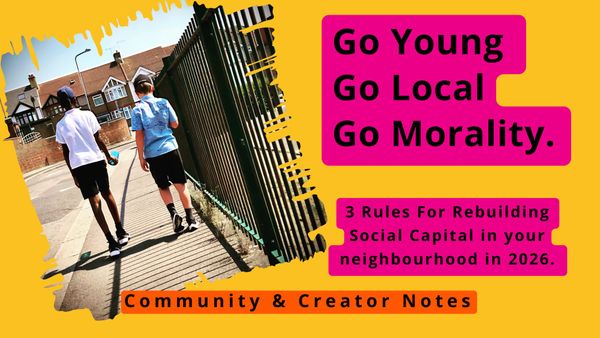
Robert Putnam — whose book Bowling Alone named this disconnection back in the mid-90s — was asked by Trevor Noah: what do we do now?
Three things, he said.
Go young. Focus on young people. Get them building something new.
Go local. Every major social revolution has bubbled up from the bottom. People collaborate across divides more easily at a local level because someone has to fix the sewers.
Go morality. Not religion as identity. Religion as a we phenomenon, not an I phenomenon. The golden rule — applied to each other.
That's not a political programme.
That's a description of what's already happening in Urban MBA, in Blue Garage, in Space4, in coworking spaces where the operator has decided to be a citizen rather than a landlord.
Monday domino
One small thing. Not a transformation. Just a domino.
Find one independent business in your neighbourhood this week.
A café, a bookshop, a florist, a repair shop. Leave them a Google review. Tell one person about them.
You already know it's good for you.
Bernie's picks:
📖 Community: The Structure of Belonging — Peter Block
📖 Bowling Alone — Robert Putnam
📺 Better Things, Season 5 — especially "Ephemera"
🎙️ Kofi Oppong on the Coworking Values Podcast
If you're running a space or building community at street level, join us at Space4 on May 19th. No keynotes. No panels. Just small groups working through the survival questions together.