
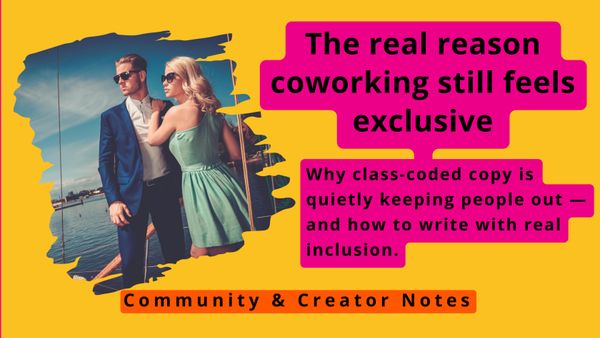
The real reason coworking still feels exclusive
Why class-coded copy is quietly keeping people out — and how to write with real inclusion

What if the true gatekeeper in your coworking space isn’t the price tag or the front desk, but rather the voice on your website?
Every week, I scroll through posts and newsletters from coworking brands in London and beyond.
Some are poetic.
Some are polished.
But too many speak to just one kind of person:
- The person who’s already in
- The one with savings, security, and social capital
- The one who laughs at jokes about artisanal bread, rooftop yoga, and school fees
And I keep thinking:
WTF: If this is what inclusion looks like…
Who’s being included?
This week, I want to unpack one of coworking’s quietest gatekeepers —
and show how to write in a way that builds a genuinely inclusive community.
Let’s walk through it.
🤖 AI for Coworking Scorecard - Too many tools and not enough time?
This free quiz helps you understand where you stand with AI—and what to automate first in order to reclaim 7–11 hours each week.
→ Start here
I knew I wasn’t the target, and I was sitting at the table.
A while back, I attended a coworking industry lunch, one of those relaxed, insider gatherings filled with warm people.
The host opened with a light joke:
“Normally, when I meet up with friends, we’re all complaining about school fees… but now it’s the price of…”
Everyone chuckled.
I didn’t.
Not because I was offended.
Because it didn’t land.
We don’t complain about school fees.
We send our kids to state schools.
The joke wasn’t cruel.
It wasn’t elitist.
But it said something quiet and familiar.
In coworking, we often assume our audience has more money than they do.
When your copy sounds like a Michael McIntyre routine
I notice the abundance of content in the London coworking scene and beyond, aimed at affluent and middle-class individuals.
You can hear it in the tone of the brands.
They describe scenes like:
“I was on my way to my local French restaurant but couldn’t find anywhere to park my jet ski, so I slipped in beside Arabella's horse box (really! Who drives a horse box in zone 1?) and realised I’d forgotten to grab a fresh pair of Birkenstocks.”
It’s not meant to exclude.
But it screams privilege, and most of the time, the people writing it don’t even realise.
It’s the sort of thing comedian Michael McIntyre would deliberately say to take the mickey out of himself for being posh, middle-class and living in Islington.
And here’s the thing:
I’m a straight, white, public school–educated European man.
This stuff lands with me.
But that’s precisely why it worries me.
If I’m wincing and throwing up in my mouth, who else is it quietly pushing away?
📍 Let’s talk about London.
Not the fantasy — the postcode lottery.
I lived in central and East London for thirty years, so I know this beast well, from Hampstead to Newbury Park and Brick Lane to Upton Park.
At first glance, London appears to be a wall-to-wall opportunity.
Zoom in, though?
London is home to some of the wealthiest neighbourhoods in Europe — and some of the poorest.
Often in the same borough.
Sometimes on the same street.
- In Kensington & Chelsea, you’ll find £15 million townhouses next to overcrowded social housing and Grenfell Tower.
- It’s the most unequal borough in the UK.
- In Tower Hamlets, Canary Wharf’s glass towers look down on a borough where nearly 50% of children live in poverty.
But this isn’t the kind of poverty that gets televised.
It’s quiet.
It’s close.
It hides behind the “good area” postcode.
‘Second Home’ didn’t open in poor boroughs — or did they?
'Second Home' — one of London’s sleekest coworking brands — opened in:
- Spitalfields (Tower Hamlets)
- London Fields (Hackney)
- Clerkenwell (Islington)
- Holland Park (Kensington & Chelsea)
On paper, these are “desirable” areas.
But look deeper:
- Hackney has one of the UK’s highest child poverty rates
- Islington ranks worst for income deprivation in London — rent takes 60%+ of the median wage
- Tower Hamlets is home to the highest child poverty rate in the UK
- Kensington & Chelsea has families leaving — even £100k isn’t enough to stay
So when coworking brands open in these spots and pitch to the Brompton-riding, Birkenstock-wearing brunch crowd…
Who are they actually building for?
Affluence is visible. Poverty isn’t.
Here’s the thing:
You can see who’s doing well.
You can’t always see who’s barely hanging on.
In nearly every borough, there are people:
- Freelancing to avoid losing a visa
- Starting again after a redundancy
- Skipping meals to keep a client project alive
They walk past your A-board every day.
They read your Instagram captions and wonder:
“Is this place really for someone like me?”
If you want to build community, your answer needs to be:
Yes.
Loudly.
Clearly.
Without assuming someone can casually spend £450 a month on a desk to belong.
Don’t confuse hospitality with luxury.
There’s something else at play here — something that often gets muddled:
People confuse hospitality with luxury.
Coworking doesn’t need to be for everyone.
Pretending it is — when your prices, perks, and positioning contradict this — makes your brand appear confused or insincere.
I have no issue if your space is unapologetically premium.
If you're aiming for the “Rolls-Royce of coworking,” fucking own it!
Rolls-Royce doesn’t show up at car expos hoping to impress the masses; they roll into yacht shows and private jet exhibitions because they know exactly who they’re for.
That’s a luxury and a strategic, selective, and intentional approach.
But don’t mistake luxury for hospitality.
As Will Guidara says:
“Service is black and white. Hospitality is colour.”
Luxury is marble countertops and filtered water in glass bottles.
Hospitality is noticing someone’s overwhelmed and making space — emotionally, physically, relationally.
It’s the act of choosing to care.
Of making someone feel seen.
You can charge £500 a month and still practice radical hospitality.
But if you're chasing status while claiming inclusivity?
People will feel the disconnect, and they’ll quietly walk away.
The £400 quote missed the whole point.
runs Creative Coworkers Collective, a high-trust, low-cost meetup for London freelancers and writes here on Substack.
No Prosecco.
No panels.
Just laptops, honest work, and genuine connection.
She reached out to a few coworking spaces to ask if they’d host a couple of hours of community-led coworking.
The reply?
A £400 quote.
Not extortionate.
But a complete miss.
They didn’t ask:
- Who are you bringing?
- What’s the purpose?
- Is this a one-off, or the start of something real?
Because that’s the point.
They saw a transaction.
Lucy was offering an invitation to build something regenerative.
“We talk about making spaces more inclusive — but not affordable.”
That line stopped me cold.
Because if you’re not including people who can’t pay full price —
You’re not including them at all.
“The community isn’t in the building. It’s in the invitation.”
That’s Lucy again.
Her crew didn’t start with a coworking plan.
They started in hotel lobbies.
Thursday cafés.
WhatsApp groups.
Pubs.
No logo.
No perks.
No funding.
Just people turning up for each other.
“It wasn’t branded. It wasn’t funded. It wasn’t part of any coworking operator’s funnel.”
And still — it worked.
Because the magic wasn’t in the building.
It was in being seen.
In having somewhere to land.
In someone turning up and saying:
“Sit here.”
Your action step this week
Look at your last 3 Instagram captions.
Your homepage headline.
Your email welcome sequence.
Ask:
“Would my mate, who’s freelancing part-time while caring for her mum, feel like this was for her?”
If not, rewrite.
Bernie’s Picks
📘 Book – Richard Pryor - Pryor Convictions: And Other Life Sentences
Richard Pryor writes like a man on fire!
This book isn’t about fame—it’s about pain, power, shame, and survival.
If you care about telling human stories, this is your north star.
→ Read here
🎧 Podcast – Real Community, Not Just Coworking (with Lucy McInally)
What does real belonging feel like—and what happens when we price it out?
This conversation with Lucy is warm, honest, and quietly radical.
She shares how running grassroots freelancer meetups shaped her view of community, not as a brand strategy but as something you build by showing up.
🛠 Tool – Upbase
Like Trello, but without all the noise.
Upbase gives you just what you need: calm structure, a brilliant Google Calendar integration.
Simple daily/weekly pages that help you see where you’re heading — and what matters now.
💬 Two things for you—because the real community needs both care and clarity
💡 Unreasonable Connection
A private monthly gathering for independent coworking operators and community builders who give a shit - next one is the 18 June!
No fluff. No man-els. Just people showing up for each other.
🤖 AI for Coworking Scorecard
Too many tools, not enough time?
This free quiz helps you see where your space stands—and what to automate first to reclaim 7–11 hours a week.
Thank you for your time and attention today
— Bernie 💚
p.s.
Written by