
The Man Who Coined “Coworking” (And What We Lost Along the Way)
Bernard De Koven invented the term in 1999 as “social technology for working together as equals” - then corporate scaling buried his collaborative vision under premium amenities and profit metrics.

📣 Hello, Substack readers - over the next few weeks, I’ll be bringing this weekly newsletter back to my website.
As simple as Substack is to post a newsletter, many long-time readers have messaged me directly to say that their Substack newsletters get lost in their inbox.
And of course, there is the ‘building on someone else’s land’ thing. While I have been here on Substack, I’ve wildly neglected my website, and good websites need love.
You don’t need to do anything, but I’ll be sending from somewhere else, and I wanted to warn you up front.
I like Substack, and we host the Coworking Values Podcast on Substack, and that is where all the energy will be focused on this platform.
Now, let's get into today’s reckoning and ruckus-making!
So Reader,
Last week, I wrote about whose voice gets heard in our industry story.
Most independent operators—the ones actually building community—are too busy running spaces to fill out surveys.
Meanwhile, corporate chains have entire teams dedicated to data collection.
So guess whose story gets told?
Here’s what we rarely discuss: the person who actually coined the term “coworking” has been almost completely forgotten. And what he originally meant by the word has been buried under corporate scaling strategies.
The Original Coworking DNA
Bernard De Koven coined “coworking” in 1999, describing what he called “working together as equals.”
Not Brad Neuberg. Not the tech bros in San Francisco. A game designer and “fun theorist” who saw something the rest of us missed.
De Koven’s coworking wasn’t about shared office space at all. It was social technology—a way to fundamentally alter how people work together without the hierarchy that “separates them by rank and salary level; creating, for the majority of employees, an indelibly competitive relationship.”
No revenue models. No scaling strategies. No premium amenities.
Just humans figuring out how to collaborate without the corporate bullshit that usually kills genuine partnership.
In 2013, De Koven reflected on how the coworking movement had evolved:
“The genius of what became the Coworking Movement was to create an entirely different approach to ‘working together as equals’... people were free to help each other without worrying about competitive pressures. And the result was productivity, community, and, surprisingly often, deeply shared fun.”
That last part—”deeply shared fun”—is crucial. Because De Koven understood something deeper about collaboration.
Play as a Political Act
For De Koven, play is a political act.
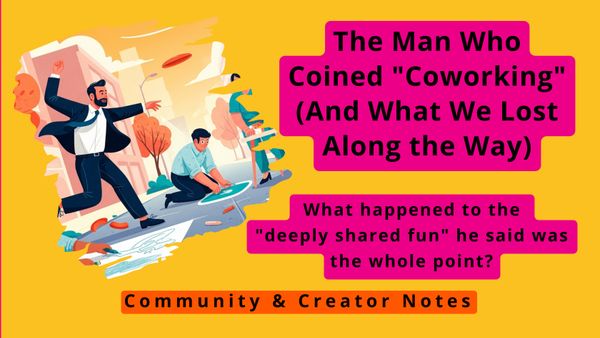
When adults play publicly—throwing a Frisbee in business attire, dribbling a basketball down a city street—they’re making a declaration of freedom. Refusing to be terrorised by the expectation that everything must be serious, productive, and optimised.
He called a Frisbee in the hands of business people a “weapon against fear.”
This isn’t frivolous. It’s about proving that hope and joy are still accessible even when the world feels harsh. It’s about choosing participation over passive consumption.
“I have no time for politics” usually means one of three things: you have no voice, you’re too comfortable to give a shit, or you’re scared of upsetting the people who pay your bills.
I know because I was that person. Until my Argentine wife called me out during the 2010 UK election when I boasted that “politics doesn’t affect me.” She made me understand that only privileged people can afford to say such things.
I’ve been awake ever since.
The connection between play and politics runs deeper than most realise. Maria Montessori understood this too—in her 1926 speech at the League of Nations in Geneva titled “Education and Peace,” she argued that lasting change comes through education, through learning new ways to be together, not through traditional power structures. “All politics can do is keep us out of war,” she said. Real peace comes from collaboration.
When Artists Perfect the Method
Choreographer Twyla Tharp spent decades perfecting what De Koven theorised.
In “The Collaborative Habit,” she documents the gritty reality of creating high-stakes, creative work with others. Not the Instagram version of collaboration—the version where egos dissolve, ownership disappears, and something genuinely new emerges.
Tharp’s breakthrough insight echoes De Koven’s concept of “working together as equals”: “There is no ownership in successful collaboration.”
When Jerome Robbins saved the musical A Funny Thing Happened on the Way to the Forum with a single diagnostic insight—”It’s a comedy. Tell them that”—he didn’t bill for consultation hours. He donated his expertise to the collective creative goal.
The idea belonged to the work, not to him.
This is exactly what De Koven meant by people being “free to help each other without worrying about competitive pressures.” When collaboration works, individual brilliance serves the shared purpose rather than competing with it.
What We Lost: The Middle Gets Squeezed
What the corporate coworking story doesn’t tell you: the people who most need collaborative workspace are being priced out by the industry supposedly serving them.
The middle class is being hollowed out. Traditional employment has fractured. More people than ever are freelancers, micro-entrepreneurs, remote workers trying to build something sustainable near home.
Amazon announced a major reduction of its corporate workforce in October—14,000 jobs, heavily targeting white-collar roles in divisions like Retail, Human Resources, AWS, and Devices.
Back in 2018, people in Philadelphia saw this coming. Instead of waiting for Jeff Bezos to deliver 50,000 jobs through HQ2, they started 10k.city to create 10,000 local jobs themselves. How right they were.
These are coworking’s natural constituency—exactly the people De Koven envisioned when he wrote about “working together as equals.”
But while they’re struggling with cost-of-living crises, our industry champions premium amenities and high-end spaces. We’ve reintroduced the very competitive pressures that De Koven’s original vision was designed to eliminate.
In London, 51% of coworking spaces are run by micro and small businesses. They understand the economic reality because they’re living it.
Meanwhile, corporate chains measure success by revenue per square foot and occupancy rates—metrics that have nothing to do with the collaborative social technology that made coworking valuable in the first place.
We’ve accidentally recreated the hierarchy-driven business world that De Koven was trying to solve. Premium members get better amenities. Scale matters more than community. Individual success trumps collective benefit.
This isn’t about corporate versus independent being bad versus good. Who doesn’t love sitting in XCHG at 22 Bishopsgate, looking out at London’s skyline?
Urban MBA ran their first year-long course and London Fashion Week show from there in 2022.
We can have both. This is about evolution.
About building work, technology, and society that serves human collaboration rather than just profit extraction.
The “deeply shared fun” got lost somewhere between the Series A and the IPO.
What Victory Actually Looks Like
This week, New York elected Zohran Mamdani as mayor.
A 34-year-old democratic socialist who built a campaign on working together as equals. Sound familiar?
Mamdani cracked the one-million-vote barrier for the first time since 1969 while generating a record-breaking turnout that surpassed 2 million voters. His victory shows De Koven’s social technology working at a massive scale.
Over 100,000 volunteers knocking doors, calling voters, organising in unions and communities.
- No corporate hierarchy.
- No billionaire puppet-masters.
Just people collaborating around shared material interests—exactly what De Koven meant by being “free to help each other without worrying about competitive pressures.”
The city’s ruling class spent over £40 million trying to stop him. When billionaire hedge fund manager Bill Ackman and even Trump himself opposed him, it backfired. The consolidated opposition proved the collaborative threat was real.
Mamdani’s coalition crossed traditional boundaries—not through identity politics, but through shared economic reality. Young voters, voters of colour, renters, and the working class all united by the issue of affordability. All of them were squeezed by the same forces, all finding power through genuine collaboration.
His platform reads like De Koven’s original vision made policy: fare-free bus service, universal childcare, and city-owned grocery stores. Taking essential services out of the profit system because not everything needs to be monetised to work.
Reclaiming the DNA
The February London Coworking Assembly event is practising De Koven’s original vision.
No keynote speakers. No gurus. No vendor pitches. Just 150 community builders workshopping real problems in small groups, then pooling solutions.
BarCamp style. Collaborative problem-solving. The expertise in the room, unlocked through a structure that serves a shared purpose rather than individual ego.
This is what De Koven called “working together as equals”—and what corporate coworking lost when it started optimising for profit instead of collaboration.
The Urban MBA screening of the ACTionism film on 17th November, near Old Street (RSVP here), showcases what happens when community spaces become platforms for genuine democratic participation. Screenings like this are popping up everywhere in coworking spaces. They’re fun and get people talking about what’s actually possible when we work together.
And yes, filling out the Deskmag - The Coworking Magazine - Coworking Trends Survey matters. It’s not admin work. It’s an act of citizenship. Making sure independent voices get heard in conversations that shape our industry’s future.
Because right now, corporate chains are telling our story for us—and they’ve forgotten where the story began.
The Choice We’re Making
De Koven understood something we’ve forgotten: collaboration isn’t a soft skill you add to business models. It’s social technology that can fundamentally alter how humans organise productive work.
The fact that I share his name and only discovered him a few years ago proves how thoroughly we’ve lost the thread. If the industry remembered its collaborative roots, his insights would be everywhere.
Instead, we argue about amenities while the original vision—people helping each other without competitive pressure—gets buried under scaling strategies and premium positioning.
Tharp proved this collaborative approach works in high-stakes creative environments where egos usually kill everything good.
Mamdani showed it can defeat oligarchic power at the city scale when everyone joins in.
The question isn’t whether “working together as equals” works. It does.
The question is whether we’ll remember that coworking was designed to be collaborative social technology, not just another real estate product for the professional class.
I’ve always winced at anything that has to point out it’s “professional networking” or “for industry professionals”—years ago, when I ran networking events in London, I went out of my way not to use that wording on purpose.
Because if we keep pricing out the people who actually need what we’re offering, we’ll end up with beautiful empty spaces serving nobody in particular—and we’ll have lost the “deeply shared fun” that made any of this worthwhile.
Your Monday Domino
1️⃣ Then draw something. Anything. For 5 minutes. De Koven said a crayon in an adult’s hand is a weapon against conformity. Don’t make it good. Just make it yours.
2️⃣ This week: Fill out the Coworking Trends Survey. Not because someone told you to, but because the stories that shape our industry’s future get written by the people who show up.
Independent operators built 51% of London’s coworking market while juggling spreadsheets, WhatsApp groups, and emotional labour.
Time to make sure that story gets told—and that De Koven’s original vision of working together as equals doesn’t get lost forever, because the light is on and burning brightly for the masses.
Bernie’s Picks
🎙 The Storyteller in the War Zone on Coworking, Community, and Survival with Helga Moreno on the Coworking Values Podcast 🇺🇦
➡️ 🎙️How ACTionism Screenings Help Members Go From Solo Mission to “I’ve Got a Crew” with Ellie Meredith on the Coworking Values Podcast.
🎙️Why Most Hardware Startups Miss Out on Grants (and How to Fix It) by BLUE GARAGE 💙 hosted by @ Dilly S. and Michael Korn
📱I’ve been using the Voicenotes app more than ever to capture ideas and structure my day.
☮️ Jewish Voice for Peace - How to Have Hard Conversations
📖 Bad Daughter by Sangeeta Pillai (Soul Sutras) — Get it here and leave a review
Thank you for your time and attention today!
Bernie 💚🍉
Community is the key 🔑
p.s. On the 17th November Urban MBA is hosting their screening of ACTionism near Old Street - RSVP here.
Written by