
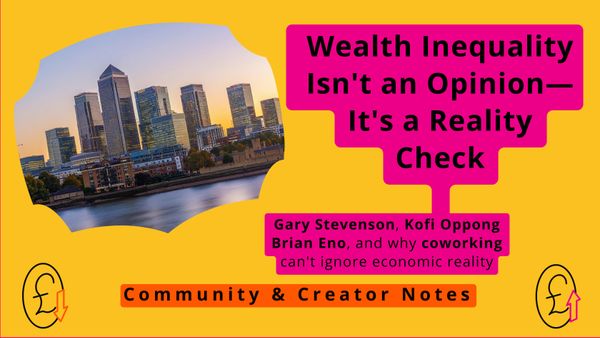
Wealth Inequality Isn't an Opinion—It's a Reality Check
Gary Stevenson, Kofi Oppong, Brian Eno, and why coworking can't ignore economic reality.

From Personal Rituals to Harder Conversations
Last week, we talked about personal rituals—those small, powerful actions that anchor you when life gets chaotic.
Returning to London, I realised that stability isn’t dull—it’s quietly powerful.
But stability isn’t just an individual need.
It’s collective.
It’s societal.
And right now, stability feels like an endangered species.
This week, let's talk honestly about wealth inequality.
Because if we don’t, everything else we’re building—community, coworking, connection—is just polishing mirrors.
Gary Stevenson vs. Diary of a CEO: When Reality Meets LinkedIn
I watched Gary Stevenson on Diary of a CEO last week, discussing wealth inequality with Daniel Priestley and Steven Bartlett.
Seeing this level of dialogue in such a mainstream setting felt like progress.
Initially, it seemed like everyone agreed: the system is fucked.
But then, in the comments on LinkedIn and YouTube, the knives came out.
I was gobsmacked at how sharply Priestley put the boot into Gary on LinkedIn.
In the comments, people prefaced their critiques with, "I come from a working-class background too, Gary, but..."
I love Gary’s passion. But.
Then, all proceeded to kneecap him publicly - losing the opportunity to further the conversation.
I always notice how personal stories get spun to suit the narrative in situations like this.
Stories about overcoming hardship—but without ever being truly marginalised.
Never needing a food bank.
Never ticking boxes labelled "hard to reach," "underserved," "vulnerable," or simply "other."
Sure, I could tell you how my mum was a primary school teacher, my dad a staff nurse in a psychiatric hospital, and how tough it was to make ends meet.
Or I could tell you the parallel story of how I got a bursary to a public school, which technically made me "a public schoolboy."
Both stories are true.
I connect deeply with Gary's experiences because I’ve been shape-shifting between different social classes at work, in my family, and in school all my life.
I've moved through similar worlds: teaching kids near Chrisp Street Market in Poplar, East London, and serving pizza at Lakeside Shopping Centre.
Working in five-star Mayfair hotels where celebrities and bankers flashed more cash on one round of Laurent-Perrier Rosé champagne than the school's entire weekly lunch budget.
It's easy to dismiss Gary's message as "tax the rich," but that's not his only point.
The bigger question is: why do we tolerate wealth inequality at this obscene scale?
Brian Eno: "Being Poor Is Expensive"
Brian Eno recently summed up wealth inequality perfectly—no hype, just clarity:
"If you get a little bit rich, you’ll likely get richer.
If you get poor, you’re likely to get poorer.
Those things aren't self-correcting."
Being poor is expensive.
This isn't about charity; it's about creating systems that reduce poverty, increase fairness, and improve everyone's quality of life.
Brian Eno, Bette A, and Jon Alexander recently shared a conversation at The Conduit in London.
Brian wrote the foreword to Jon's groundbreaking book Citizens, published in 2020.
This book has strongly influenced our direction at the London Coworking Assembly.
The overlap is clear: community and citizenship are built through collective responsibility, not individual philanthropy.
Mind the Gap: Kofi Oppong on London’s Wealth Divide & Real Solutions
On Friday, I sat down with our friend Kofi Oppong—founder of Urban MBA.
This topic isn’t theoretical in his world.
It’s alive and fucking kicking in the community he’s built.
Kofi said something that’s stuck with me:
“This isn’t about becoming a tech unicorn. It’s about staying alive.”
For many in disadvantaged communities, entrepreneurship isn’t a personal development story—it’s a survival strategy.
Not “build your brand” vibes. (But Kofi does love a brand!)
It's more like avoiding eviction, supporting your family, and staying one step ahead of the system.
We talked about how the phrase “no one’s coming to save you” is used on Instagram as a motivational quote.
But Kofi’s experience strips the polish off that line.
It’s not a mindset—it's a structural reality.
When there’s no family safety net, connections, and second chances, entrepreneurship without access becomes a pressure rather than a possibility.
“They’ll tell you to hustle harder—not that the game is rigged.”
This is especially relevant after watching the Gary Stevenson backlash.
It’s easy to dismiss systemic critique when you’ve never lived on the edge of it.
But Kofi has.
And through Urban MBA, he’s helping others navigate it—with real tools, not vibes.
We also talked about 22 Bishopsgate, where Caleb Parker arranged for Urban MBA to run its first year-long course in 2022.
That space is a collision of two Londons: prestige skyscraper meets community impact.
It’s not about photo ops.
It’s about helping people feel seen, safe, and supported.
“You don’t build social capital with TED Talks. You build it when people eat together and speak.”
Kofi’s work and the epic Urban MBA community show that change doesn’t come from podcast panels.
It comes from turning closed doors into open rooms.
The Middle Class Is the Coworking Industry’s Core Customer
Most coworking spaces in London are designed for the middle class—freelancers, small businesses, and creative professionals.
People who reject corporate offices crave structure, connection, and decent coffee.
But as the middle class gets squeezed, coworking spaces start wobbling, too.
If people can't pay rent, they won't spend £500/month on a coworking with artisan sourdough.
We already see the erosion: rising churn, late payments, and fighting for event RSVPs.
As Gary Stevenson says, "The money is being hoovered upwards."
Coworking flourishes when people feel hopeful and stable.
But right now, many feel precarious and anxious, one invoice away from collapse.
And when survival mode kicks in, the community slides down the priority list.
Canary Wharf, Mirrors, and Missed Chances
I keep thinking about Gary Stevenson describing the view from Ilford, where I lived for 20 years—staring at the towers of Canary Wharf, wondering what happened inside.
I know that view intimately.
When I first worked in Canary Wharf, there was only one tower.
Later, teaching near Chrisp Street Market, I'd cycle into the city towards my restaurant job near Broadgate Circle, past Canary Wharf looming on my left, and wonder:
How could wealth and poverty sit so comfortably side by side?
Bankers, glowing orange from fake tans, wearing pink shirts and sipping champagne.
They'd casually spend thousands on rounds of Laurent-Perrier Rosé—matching the weekly lunch budget for the school I’d just left.
On the night of the 9/11 attacks, an investment bank cancelled their reservation at our restaurant—a party for 250 people, totalling £25,000.
They still paid for the food, the staff, and the service, which, given the situation, felt decent then.
So, on 9/11, I got a night off, fully paid with tips, but it certainly did not feel like a win.
But looking back now, the sheer scale of what was considered a routine entertaining expense is staggering.
Just because we're inside the building doesn't mean we've "made it"—often, we're deeper in the machine.
Coworking’s Comfortable Blind Spot
There's an irony about London's coworking culture:
Affluent creatives in stylish spaces like the old Second Home in Hackney sip Climpson & Sons flat whites and binge-watch Top Boy, captivated by its gritty realism.
Yet oblivious to real struggles at the Ann Tayler Children and Family Hub, mere steps away.
This isn't cinematic dystopia; it's 2025 London reality—often hidden behind Instagram-perfect coworking fantasies.
Take Action: Event Planning Series—Next Session This Week
Last year, our sessions with Jon Alexander on active citizenship showed us clearly: find the others.
We began with "Unreasonable Connections" and are now running our free European Coworking Day Event Planning Series.
This isn't charity or another thing to overwhelm you—just five practical sessions to help bring communities together through meaningful events.
Even if you're not sure you'll run a European Coworking Day event, you'll leave with clearer tools, fresh ideas, and new connections.
We’ve done the big-picture talking—now it’s time to take clear, practical action.
London has 1300 coworking spaces.
We're aiming for 100 to step up and build something.
🛠 RSVP for the event planning sessions
Thanks for taking the time to read this.
Let’s keep building something better—together.
Bernie 💚
Written by