
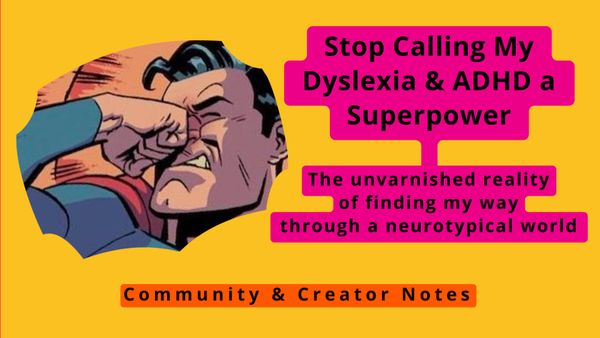
Stop Calling My Dyslexia & ADHD a Superpower
The unvarnished reality of finding my way through a neurotypical world—the tools that help, the challenges that persist, and why I wish I'd known all this when I was 20

I really don't like it when people describe dyslexia, ADHD, and other neurodivergent traits as "superpowers."
That framing isn't just wrong—it's actively harmful. It erases the daily struggle, the constant adaptation, the mental toll of functioning in a world that wasn't built for brains like mine.
I've been developing workarounds to function in mainstream environments for years.
Some of these adaptations have become unconscious skills, like my ability to process enormous amounts of information through audio while walking around Vigo.
But these aren't gifts.
They're survival mechanisms born from necessity.
Today, I want to share the unvarnished reality of finding my way through a neurotypical world—the tools that help, the challenges that persist, and why I wish I'd known all this when I was 20, because large chunks of my career would've been a lot fucking easier.
Let's get into it.
The "superpower" narrative ignores the exhaustion of constant adaptation.
Every time someone calls neurodivergence a "superpower," I want to invite them to live in my brain for a week.
They'd experience the mental intolerance and coping I've had to become aware of throughout my life to function.
Sure, it's interesting and extraordinary, but it's also anxiety-inducing, depressing, and exhausting.
What looks like a special ability from the outside is often just the visible tip of an adaptation iceberg.
Beneath the surface are years of trial and error, countless failures, and the persistent feeling that you're working twice as hard for half the result.
The "superpower" framing also creates a harmful expectation: if you're not excelling in some area because of your neurodivergence, you must be doing something wrong.
That's bullshit.
Sometimes dyslexia is just dyslexia—a genuine challenge without a silver lining.
Audio learning became my lifeline, not because I'm gifted but because I had no choice.
For over a decade, Voice Dream Reader has been my constant companion.
My #supercoolwife discovered Audible.com twenty years ago and set me up for life.
That was the beginning of my audio learning journey.
I can listen to and take in a lot of content via audio, even if it's boring.
Especially by listening and reading at the same time.
This is how I've acquired a lot of knowledge.
I can listen to the same boring report three times at triple speed and often arrive at meetings as the only one who's read the report.
Not because I'm more dedicated, but because I found a workaround that turned my brain's wiring into an advantage.
Being dyslexic means traditional reading is like trying to nail jelly to a wall.
The letters dance.
My focus scatters.
An hour passes, and I've processed three paragraphs.
But give me that content as audio while I'm moving?
My brain lights up.
(Just not spreadsheets, tax returns or timezone changes!)
I've "read" entire books while walking up and down hills in Vigo.
Processed research papers while cooking dinner.
Absorbed meeting notes while cleaning the bathroom.
This isn't multitasking—finding the right channel for my brain.
The tools that help me aren't "productivity hacks" but basic necessities.
I've added Google's NotebookLM to my workflow for the last year.
Voice Dream Reader feeds my brain; NotebookLM helps me understand what I've absorbed.
But expressing information verbally remains very confusing for me, verging on anxiety-inducing in some instances.
I can ad lib and think on my feet, but doing a presentation and following a script is disabling.
The tools that help me aren't optional upgrades or clever productivity hacks.
They're necessities—the difference between functioning and not functioning.
When neurotypical people use these same tools, they might get a 10% boost in efficiency.
When I use them, they a difference between participating in professional life and being excluded entirely.
Reading physical books is something I've only just worked out how to do.
I'm slowly rereading stuff that wasn't available on audio when I was at university 100 years ago.
This isn't because I suddenly developed a love for physical books.
It's because living in a quieter place like Vigo and calming down mentally have finally allowed me to engage with text on a page.
I'm still figuring out what most people take for granted as a basic skill—something they mastered at age 6 or 7, but I’m figuring it out now, just after my fourth mid-life crisis.
And that's okay.
But it's not a superpower.
It's just the reality of a brain that processes information differently.
What I excel at comes from necessity, not natural talent.
So while I may excel in particular situations, it's because I've developed coping mechanisms and had to find a way to exist to function in a mainstream world.
The areas where I appear to have unusual abilities—like absorbing massive amounts of information through audio—aren't innate talents.
They're compensatory strategies developed through necessity.
This distinction matters because the "superpower" narrative suggests that neurodivergent people should be grateful for their differences.
But would you be grateful for a condition that makes basic tasks harder, even if it occasionally gives you an edge in niche situations?
I'm not saying there aren't genuine strengths associated with neurodivergence.
There are.
But they're not free gifts—they're hard-won adaptations with significant costs.
The tools that changed everything for me.
Voice Dream Reader isn't just an app on my phone.
It's the difference between participating in professional conversations and being left behind.
The process is simple but transformative:
- Save the text (webpage, PDF, document)
- Open in Voice Dream
- Set the speed (I start at 2x and work up)
- Put on headphones
- Move my body
That last part is crucial.
Something about physical movement—walking, cleaning, cooking—helps my brain process audio information.
The two systems work in harmony.
When I'm sitting still, staring at text?
My focus fragments.
When I'm moving while listening? I'm unstoppable.
Google's NotebookLM has become the missing piece.
Voice Dream helped with input, but I still needed a better way to process and apply what I'd absorbed.
My actual workflow now looks like this:
Upload big reports, books, and my own work into Google NotebookLM
Listen back to the podcast created in the app
Use the mindmap feature in NotebookLM while doodling on a notepad.
Discover new layers or expose gaps in my thinking as I hear two people discuss the content in the AI podcast.
Listening to transcripts of podcast episodes echoed through NotebookLM has helped me hear ideas I didn't even realise were there.
This approach helps me understand and feel what is happening, especially with my work.
Hearing the AI-generated conversation reveals new dimensions I'd miss otherwise.
For example, hearing Google NotebookLM discuss episodes of the brings ideas for new episodes and how to build out written content like what you're reading here to expand on stories and themes.
Now that the app is on iPhone, everything is even more connected.
Anyone studying at any level without using Google NotebookLM is missing a trick.
I wish I'd known all this when I was 20.
Large chunks of my career would've been a lot more fucking manageable if I had understood my brain earlier.
- I wouldn't have spent years feeling stupid when I couldn't focus on reading.
- I wouldn't have struggled through presentations thinking I just needed to "try harder."
- I wouldn't have internalised the idea that my difficulties were character flaws rather than neurological differences.
The tools that exist now didn't exist then.
The understanding exists now that didn't exist then.
But the "superpower" narrative still does more harm than good.
It creates an expectation that neurodivergent people should be exceptional in some way to "make up for" their differences.
The reality is messier, more nuanced, and ultimately more human.
🧰 Bernie's Picks
📖 Book – “Everything Is Connected” by Daniel Barenboim
I'm reading this book right now, and it's not what you'd expect.
It's not a business book. It doesn't care about your KPIs.
There are no "frameworks for success."
It's about music. War. Listening. Dignity. Silence.
Barenboim was born in Argentina, raised between Buenos Aires, Israel, and Europe, and was a pianist before he could ride a bike.
He grew up crossing borders between languages, cultures, and religions.
And instead of picking a side, he built an orchestra.
He created the West-Eastern Divan Orchestra with Edward Said, a Palestinian-American academic, literary critic, and political activist who was a literature professor at Columbia University.
(Twenty years ago, Edward Said’s book “Orientalism” changed the way I thought and what I noticed around me.)
I’m a white, Catholic, European man living in a country where I don’t fear the knock at the door.
The Orchestra, now 25 years old, consists of Israeli and Palestinian musicians playing on the same stage.
Not in agreement. Not in harmony. Just... together.
Barenboim didn’t write this book to soothe us.
He wrote it to remind us that music is political, not because it picks sides, but because it refuses to stop feeling.
Because it forces you to listen when everything in you wants to talk.
Because it demands that you spend time with someone you disagree with or don’t even like.
This book grinds my eyeballs and sinuses because if community only exists when we're comfortable, then it's not community. It's theatre.
ONE MORE TIME - for the people at the back:
If community only exists when we're comfortable, then it's not community.
It's theatre.
If your community can't hold contradiction, if it can't hold different ways of thinking and processing in the same room, then maybe it's not a community.
Maybe it's just a curated feed with better lighting.
Community isn’t tested when things are easy.
It’s tested when people disagree, and still choose to stay in the room.
For those of us who don't fit neatly into neurotypical boxes, this resonates deeply.
We're not asking for special treatment—just the space to exist differently without being forced to choose between hiding or performing.
💡 App – Google NotebookLM (Free)
This tool has transformed how I process information. I upload big reports, books, and my own work, then listen to the AI-generated podcast discussions.
Anyone studying at any level who does not use Google NotebookLM is missing a trick, especially if their brain works differently.
What I want you to take away from this.
If you're neurodivergent: Your adaptations aren't superpowers—they're hard-won survival skills.
Be proud of them, but also acknowledge the cost.
Struggling doesn't mean you're broken—it means the system wasn't built for you.
If you're neurotypical: The next time you're tempted to call someone's neurodivergence a "superpower," pause.
Consider that what looks like a special ability might be an exhausting compensation strategy.
For everyone: The tools that help neurodivergent people aren't "special accommodations"—they're basic necessities for equal participation.
And they often make life better for everyone.
The most powerful question I've asked myself isn't "How can I overcome my dyslexia?" but "What if traditional reading isn't the only way to learn?"
This attitude to education is why I’m a die-hard fan of Urban MBA.
This week, I challenge you to question one "normal" way of working that's always felt like a struggle.
Ask yourself:
- What if this isn't the only way?
- What if my difficulty isn't a deficiency, but a sign I need a different path?
- What if my workaround could become my advantage?
The tools that liberate us don't just make us more productive—they make us more ourselves.
Two things for you!
📧 Free Email Course – 5 Mistakes Coworking Community Builders Make
Unreasonable Connection is our monthly online, informal, and open event for people who own or run coworking spaces who want to connect.
🎟️ RSVP here → https://lu.ma/6x8af9dd
Thank you for your time and attention today — Bernie 💚
Written by