
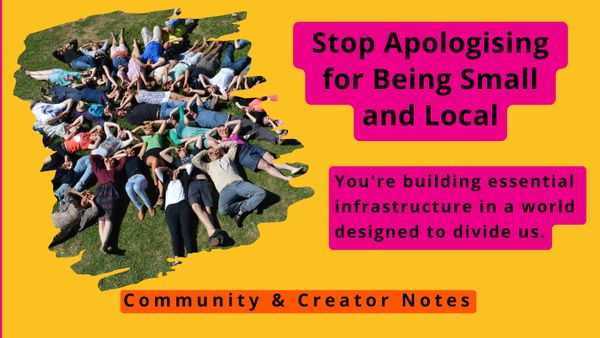
Stop Apologising for Being Small and Local
You're building essential infrastructure in a world designed to divide us
A few weeks ago, before my cousin died, I was in a packed bus heading up into the mountains to Vigo airport.
And as buses go, it was way too packed.
My cousin’s daughter was coming to stay with us for a few days, and we knew my cousin was near the end of his life; we did not think it would be the week after this.
I was pressed against the window in the area reserved for push chairs and wheelchairs.
It was very hot; children were laughing and crying. There were elderly ladies with huge bags of shopping, and the 'Camino de Santiago' people were all kitted out in their trade mark Quechua gear.
But I knew this overcrowding would only last until the edge of town, then, as we go further into the hills to the airport, the breeze will become stronger, and the view will become even more glorious.
For the last 20 years, being in a cramped, hot space, standing up in transit with other members of the human race, always instantly transports me back to February 2005 in Poland.
February 2005.
I was in a small white minibus reading Primo Levi on the way to visit Auschwitz for the first time.
At that very moment, his words about the train full of Italian Jewish people travelling from Italy to Poland were etched into my memory forever.
(The 2024 movie A Real Pain reminds me of this minibus trip in Poland.)
What haunts me isn't just the horror Levi describes. It's the calm, gentle way he writes about our capacity for cruelty. How humans in the most desperate states become the most savage. How systems are designed to dehumanise work precisely as intended.
Twenty years later, I can't get on a crowded train without thinking about that chapter.
1984 and Primo Levi's If This Is a Man are the two most important books I have ever read in my life; I keep coming back to them.
They taught me how language and systems can be weaponised to make the unthinkable seem normal.
And last week, I kept thinking about Orwell too.
When Language Becomes a Weapon
"WAR IS PEACE, FREEDOM IS SLAVERY, IGNORANCE IS STRENGTH"
- George Orwell
Orwell wrote those words in 1948, describing a world where language becomes a weapon, where meaning gets turned inside out until truth disappears.
We're living in that world now.
In the last two weeks, the UK Parliament voted to brand Palestine Action a "terrorist organisation."
Their crime?
Breaking into military bases and spraying red paint on planes to protest Britain's arms exports to Israel.
Look, I'd be pissed off if someone broke into my airbase and painted my war plane red—it's serious, it's inconvenient, it's illegal.
And if you're in charge of security at that airbase, it must be very annoying.
But it's not the same as flying a plane into a building.
🎥 The amazing Baroness Jenny Jones explains it here on YouTube.
In the same week, young British activists from Bite Back had their award-winning billboard campaign banned by the UK's biggest advertising companies.
Their message? "Young Activists Bought This Ad Space So Junk Food Giants Couldn't."
JCDecaux and Global—controlling 70% of the UK's digital outdoor advertising—refused to run their ads, even though they'd broken no rules.
Not because they broke any laws, but because their message about protecting children from junk food advertising made the wrong people uncomfortable.
Meanwhile, McDonald's, Coca-Cola, and Cadbury continue flooding our streets with ads targeting children.
Orwell would have recognised this immediately: the exact mechanism that makes "war" mean "peace" also makes protecting children's health a threat to be silenced. At the same time, companies profiting from childhood obesity become "innovators."
✅ See their story and email your MP in seconds here.
- Young people protecting children's health? Censored.
- Activists opposing weapons shipments? Terrorists.
- Companies making billions from death and diabetes? Innovators.
This is doublespeak in action.
The language of power is designed to make us forget what words actually mean.
The Albanese Report
Last week, UN Special Rapporteur Francesca Albanese released a devastating report titled "From Economy of Occupation to Economy of Genocide".
She named names.
Over 60 companies—including Microsoft, Amazon, Google, Lockheed Martin, BlackRock, Vanguard—as part of what she calls an "economy of genocide" that sustains and profits from Israel's operations in Gaza.
The numbers Albanese cites are staggering—billions in new market value generated in months from military conflict, regardless of the human cost.
For some, conflict is profitable.
When I saw Albanese's report, I realised I couldn't stay quiet anymore.
I'd been wrestling for months with how to respond to what's happening, not wanting to get it wrong, especially given how many Jewish friends I have and the complexity of Israel within the Jewish community.
But sometimes the best response isn't perfect words—it's using the tools we have.
I wrote about this on LinkedIn, sharing a petition that uses EU trade agreement mechanisms to hold our institutions accountable to their own rules.
These aren't fringe conspiracy theories.
This is a UN report, naming household names, showing how our everyday digital infrastructure—the clouds that store our data, the apps that run our lives—feeds directly into what Albanese documents as an "economy of occupation".
Don't feel too bad—I'm writing this on an Apple computer, I use Google Workspace, I'm a YouTuber, and I'm about to go for a walk and listen to a book on Audible, owned by Amazon. I'm trapped in the ecosystem, too.
How many B-Corps are unknowingly connected to this web?
How many coworking spaces host companies that ultimately feed this machine?
We like to think our choices are clean. But when you trace the money, when you follow the threads, we're all implicated in systems we barely understand.
🤦🏻 And don’t get me started on Spotify's Daniel Ek leads €600 million investment in AI military defence company.
How We Got Here
The comedian Mark Thomas spent years documenting how this doublespeak plays out in how the governments and corporations act, both in the UK and around the world.
I first discovered Mark in the 1990s on The Mary Whitehouse Experience with Rob Newman and David Baddiel, but I became deeply engaged in his work around the 2003 Iraq invasion - The Night War Broke Out(2004).
Back when Tony Blair's government introduced the Serious Organised Crime and Police Act 2005, legislation that prevented demonstrations within Parliament Square without prior police approval.
In response, Mark organised 20 individual protests in 20 different locations in one day, setting a Guinness World Record.
His point? The government was banking on people not being able to complete the paperwork, hoping they'd abandon their right to protest entirely.
But Mark didn't stop at exposing government hypocrisy.
In Belching Out the Devil, he traced Coca-Cola's global empire—from child labourers in El Salvador's sugar cane fields to Indian workers exposed to toxic chemicals, Colombian union leaders falsely accused of terrorism.
He showed how one company could sponsor the Olympics, back U.S. presidents, rebrand Santa Claus, and somehow still be served in space while leaving a trail of human damage across the globe.
The hypocrisy was already there. The system was already designed to exhaust dissent through bureaucracy, to make resistance so difficult that most people would give up.
And the corporations Mark exposed? They've only gotten bigger, more embedded, more untouchable.
Ten years later, we're calling young activists like Bite Back "terrorists" for trying to protect children from junk food advertising, while the companies poisoning those same children get LinkedIn roundups celebrating their innovation.
The slope wasn't slippery. It was engineered.
The Choice Is Now - Here Is What We Can Do
Recently, I've had conversations with some of the beacons in my community—people who've been building real connections for years.
They're all saying the same thing: We need to connect locally.
The internet is fantastic, but it's also a shit storm designed to divide us.
Every algorithm, every feed, every notification is calibrated to keep us scrolling past each other instead of talking to each other. To keep us angry at distant enemies instead of building something tangible with our neighbours.
We're at a moment where we can choose.
We can keep getting lost in the noise, fighting each other over words that have been weaponised to divide us, scrolling through feeds designed to exhaust our attention, feeling powerless against systems too big to understand.
But here's the thing: every hour we spend scrolling is an hour we're not creating. Every algorithm we feed is a vote for the system that's grinding us down.
Or we can do what humans have always done when everything else breaks down: step away and create together.
That protection doesn't come from better algorithms or stronger laws. It comes from people who know each other, who look out for each other, who refuse to let the machine grind us down alone.
But community is still the one thing they can't fully break down.
Not What Can I Do—What Can WE Do?
The question isn't what can I do about systems this vast, this entrenched, this profitable.
The question is: What can WE do?
Last week, our friend Lena's brother Josh lost everything to flash floods in New Zealand. Thirty minutes to evacuate, and a lifetime's worth of tools as a builder—gone.
Lena asked for help, and people have contributed nearly £1500 so far to help them rebuild. You can join others and donate here.
Unreasonable Connection July: An hour of genuine conversation. No sales pitches, sponsors, or distractions.
Just coworking community builders connecting openly about the realities, challenges, and joys of coworking. RSVP here.
Because when words become weapons, when language gets turned inside out, when up becomes down and terrorism becomes activism and activism becomes terrorism, the only antidote is human connection that can't be mediated, monetised, or manipulated.
Community isn't just the key.
Community is the only key we've got left.
Bernie's Picks
📖 Book: If This Is a Man by Primo Levi.
If you haven't read it yet, now could be the perfect moment. Levi's calm and precise language amidst unimaginable horror demonstrates how to bear witness without losing our humanity. Essential reading for understanding how systems of dehumanisation operate—and how we resist them.
📱 App: One Sec.
I'm more convinced than ever that our phones are designed to keep us isolated and reactive. This app creates just enough friction between impulse and scroll to help you choose connection over consumption.
🎧 Podcast: Why Your Coworking Space Matters More Than You Think with Helena Norberg-Hodge "We are being driven by a blind system that we support when we remain blind to it."
Helena doesn't talk about going local like it's a lifestyle choice—she talks about it like someone who's spent 50 years watching globalisation systematically dismantle communities.
On the , Helena and Tilley explain why your coworking space sits at the intersection of economic resistance and psychological healing. Essential listening for anyone who senses the future isn't digital—it's local.
I'm writing this from Vigo, looking out over the hills, feeling grateful for the distance that lets me see the patterns clearly.
But clarity without action is just another form of noise.
The work isn't understanding the system. The work is finding each other despite it.
Let's keep finding each other.
Bernie 💚
P.S. This week, check in with someone you haven't spoken to in a while. Not online. In person. See what happens when you talk about what's really on your mind. That's where community starts—one real conversation at a time.
Written by