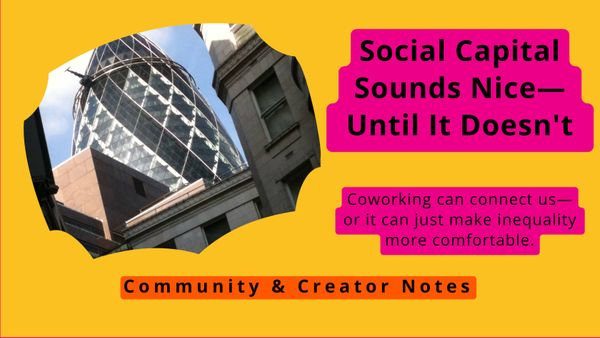
Social Capital Sounds Nice—Until It Doesn't
Coworking can connect us—or it can just make inequality more comfortable.

From Personal Rituals to Community Realities
Last week, I shared how going non-stop to London a few weeks ago—left me drained.
It's not London's fault; juggling excitement, work, family, friends, and travel has made me reflect deeply on slowing down.
I talked about stability, simplicity, and finding clarity in small rituals.
This week, I'm exploring a similar tension—but at a community level.
Stability and genuine connection aren't just personal rituals but societal needs.
And right now, we urgently need to have a deeper conversation about what "social capital" really means—especially in a struggling city.
This year, we're collaborating with Tilley and Alex at Akou to unravel the messy reality of how people genuinely connect.
Our goal?
To practically show people their links to each other in the London Coworking Assembly—hopefully using European Coworking Day events as a key part of that process.
We're cutting through the crap to find ways of measuring social capital—not just ticking boxes, but understanding what genuinely connects people, builds trust, and sparks action in London's coworking spaces.
Social Capital Sounds Nice—If You're Privileged
I was talking with a couple of people recently about social capital.
It was a good conversation until one person said, "Yeah, that sounds lovely...for people like you."
And they were right.
I know the privilege of casually discussing "building your network."
Recently, more people than ever—friends, collaborators, podcast guests—have told me how much of a struggle London is.
But it's not only London.
Everywhere I look feels exhausting and precarious.
Scrolling through endless toxic news cycles—Elon, Trump, economic inequality—is deeply worrying and relentlessly draining.
The Real Crisis Behind the Buzzwords
From Cold Water to Real Clarity
I first met Kofi from Urban MBA in 2019, and he's been bluntly calling out wealth inequality ever since—no sugarcoating or polite phrasing.
Then, in September 2024, I started following Gary Stevenson’s YouTube channel, and it felt like having cold water thrown in my face.
Gary made it impossible to ignore how sharply inequality is rising, how broken our systems are, and how urgently we need to act.
Between Kofi's grounded local insights and Gary's big-picture urgency, the message is loud and clear: we're more than a bit fucked—and only genuine community and connection can pull us out.
Why "Social Capital" Rings Hollow
But here's the tension:
Imagine going up to someone suddenly out of work or struggling with rising bills and cheerfully saying:
"Hey, maybe you just need more social capital!"
"Have you tried coworking? It's all about social capital - that will fix you!"
...Sounds absurd, right? Even insulting.
It’s like offering someone a Nurofen for a gunshot wound.
Building the Thing, Not Just Talking About It
So, our job isn't just talking about social capital.
It's about building places where it happens, especially for people who don't usually get a look-in.
Forget airy-fairy networking; we need a practical, hands-on graft.
And sometimes, that means shaking things up in the least likely places.
The Bishopsgate Collision Course
That happened in 2022 when Caleb Parker—who loves connecting the flexible workspace with the rest of the world—set up Urban MBA to run its first year-long course at XCHG 22 Bishopsgate.
Who are Urban MBA?
Give marginalised young adults essential business skills to thrive during personal challenges and build businesses.
What is 22 Bishopsgate?
One of London's most bling, priciest business addresses – the heart of corporate power.
Sticking these two together wasn't some PR stunt; it was about smashing down barriers.
In addition, Urban MBA participants always come to the London Coworking Assembly, so they quickly overcome the awkwardness of their first networking events and become actual, active members of the community.
They show up, get stuck in, and make shit happen.
Running workshops, filming podcasts, grabbing mics—not to look busy, but to connect.
It's about "access" – it was about owning it.
You don't build social capital on bullshit handshakes.
It's about working together, respecting each other, and making something that matters.
The upshot? These are not just feel-good stories.
The Urban MBA members always see their confidence rise, their networks expand, and business opportunities arise.
Canary Wharf, Mile End and Mirrors,
I keep thinking about how Gary Stevenson describes looking out across the city from Ilford—staring at the Canary Wharf towers and wondering what went on inside.
I lived in Ilford for 20 years.
I know that exact view.
I’ve stood in the same park and asked the same question.
He talks about the sound of the Jubilee line trains, the distance, the mystery—then suddenly, he's inside one of those towers, trading billions.
I worked in a brand-new Canary Wharf restaurant when there was only one tower—the original lonely skyscraper.
A few years later, while studying, I taught at a school near Chrisp Street Market, where you could see those towers looming from the playground.
Every afternoon, I'd cycle up Mile End Road towards my evening shift at a restaurant in Broadgate Circle, passing the gleaming new towers on my left and only the Gherkin ahead.
That Gherkin view is now crowded with buildings like Salesforce Tower and 22 Bishopsgate.
Even then, on that bike ride, the contrast was surreal - I still have that bike today - a GT Zasker LE.
Even all these years later, it seems nuts that one minute, I was leaving a school where kids relied on free lunches and heating that barely worked.
Twenty minutes later, I was in a Broadgate Circle restaurant pouring Laurent-Perrier Rosé bottle after bottle like it was juice.
Orange-skinned men in pink shirts, drinking pink champagne, chain-smoking Marlborough lights.
Someone always picked up the tab on their company, Black Amex—usually a few grand.
Roughly the same as the weekly lunch budget for every kid I'd just spent the afternoon teaching.
9/11 and Our Mutual Friend
I was working in that very restaurant when we heard about 9/11, a surreal moment etched permanently into that odd collision of worlds.
It was a busy Tuesday. The restaurant was packed, and everyone’s phones started to buzz.
Within 30 minutes, nearly everyone had paid and left.
At the time, I was reading Our Mutual Friend by Charles Dickens at university, cycling through streets Dickens had written about, confronted daily with the same glaring inequalities he'd exposed over a century before.
That's the London Gary talks about.
The one I know, too.
I've always carried the one I still carry because I could not understand it.
But the punchline hits hard: being inside the building doesn't mean you've made it.
You're just deeper inside the machine.
And that feeling creeps in when I walk past coworking spaces charging £500 a desk… right next to a community centre handing out nappies and hot meals.
We have to ask ourselves—what are we building here?
Because if "social capital" only lives inside paywalled spaces with craft coffee and curated panels, we're not building connections.
We're just polishing the mirrors.
Coworking's Comfortable Blind Spot
There's an irony I can't shake about London's coworking culture.
Affluent creatives in luxurious spaces like the old Second Home in Hackney sip their Climpson & Sons flat whites and binge-watch Top Boy.
They're captivated by gritty stories—but blind to the stark realities just down the street at the Ann Tayler Children and Family Hub, where underserved families gather daily for support, childcare, and meals.
Many Top Boy scenes of struggle, inequality, and economic desperation were shot just minutes from coworking spaces celebrated for their stylish architecture and lush greenery.
It's not a cinematic dystopia.
It's actual life in 21st-century London—too often hidden behind Instagram-perfect coworking fantasies.
Why does the coworking industry keep meeting in spaces most people can't afford?
Think about it.
If coworking is all about inclusion, community, and supporting local economies, why do we continue to hold conferences in spaces most Londoners could never afford to step inside?
And yes—I'm talking about myself here, too.
More than once, I've organised events on shiny rooftops with panoramic city views.
Beautiful? Yeah.
Hypocritical? Completely.
I sipped my elderflower and avocado cordial, admired the skyline, and wondered aloud how we could 'solve inequality' from twenty floors up.
I'm as guilty as anyone.
But that's precisely the point.
Suppose we're serious about real community, genuine inclusion, and economic fairness. In that case, we've got to start holding ourselves accountable for where and how we gather.
What Genuine Community Looks Like
Yet, despite all that, over the last 15 years, I've seen plenty of coworking spaces genuinely building social capital—not just talking about it:
Stephen Carrick-Davis and Edy are creating maker spaces on the high streets of Lewisham that give refugees practical skills, dignity, and jobs at Facework.
Ali Kakande, whose work connects people deeply through food, culture, and storytelling at Carib Eats.
Chauntelle Lewis runs Town Square Islington, an affordable coworking space in the heart of Old Street.
Maddy and Natasha run Space4 by Finsbury Park tube - home to Founders & Coders.
Elena runs Creative Works - the beating heart of coworking and community in E17.
Impact Brixton, where Samantha Kidjo's recent event, "The Alarming Decline in Diverse Founder Funding," sparked urgent conversations about inclusion, visibility, and fairness.
🎙️ You can hear many of their stories on the Coworking Values Podcast
POV - Impact Brixton remains one of London's best examples of genuine community connectedness.
These examples aren't shiny, "Guardian-worthy" stories—they're grounded and real.
They're creating real impact and quietly transforming lives.
Taking Action When Everything Feels Overwhelming
I get it—it's overwhelming knowing where to start.
It feels too big, too systemic, too tricky.
But here's the thing:
The solution is simpler than you might think—small, repeated, intentional acts of community-building and learning practical skills to bring people together.
Our most highly engaged events in recent years featured Jon Alexander talking about active citizenship.
There's a genuine appetite in the London Coworking Assembly community to unfuck the world—not just escape it.
One of last year's event's most explicit action steps was simple: Find the others.
We started with Unreasonable Connections, and the next step is our free European Coworking Day Event Planning Series—your invitation to get involved.
Your First Step Towards Real Social Capital
Let's be honest—talking about community doesn't build it. Showing up does.
So here's the move: one hour a week, five calls, zero bullshit.
We're running an event series where you'll learn how to host gatherings bringing people together—no TED Talk vibes, Prosecco with minor Royals and no rooftop selfies—just practical stuff that works in the real world.
Even if you never run a European Coworking Day event, you'll leave with sharper tools, new people in your corner, and a better sense of what it means to make a connection that matters.
When we get good at building a real community, we help others do the same.
London's got over 1300 coworking spaces.
We're looking for 100 who are up for doing more than handing out free coffee and calling it culture.
You can think of this as the start.
One small move towards something better.
🛠 RSVP for the event planning sessions → Here
📍 Register your space for European Coworking Day → Here
🖤 Let's make London coworking great again. 😜
Thank you for your time and attention today
Bernie 💚
Written by