
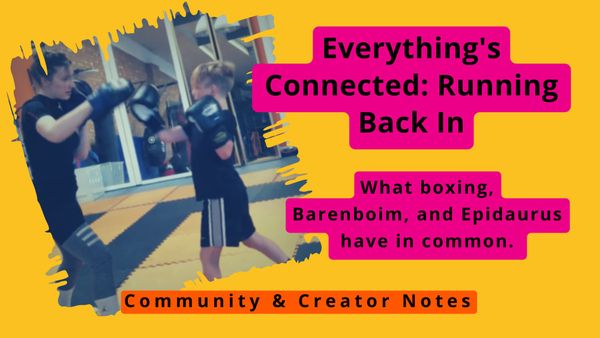
Everything's Connected: Running Back In

What boxing, Barenboim, and Epidaurus have in common.
The next “in person” Unreasonable Connection" for Coworking Community Builders is on the 19th of May, Space4, Finsbury Park.
So Reader,
Saturday night. Monday morning I go back to boxing with the Boy. I am not ready. I'm going anyway.
I knew Giedre through Urban MBA - actress, dancer, martial arts expert, big part of what makes that place what it is. I'd asked if I could bring the Boy to Urban MBA one day so she could chat with him about martial arts, show him what was possible. She had a better idea. "Just bring him to the dojo," she said.
I came thinking it was the Boy's taster session. I was there to watch.
When Master Alex walked in - and I say Master Alex deliberately, because I knew Alex outside the dojo, but inside it the code is different - he said hello and then looked at me on the sofa. "You either need to join in or go," he said. "This isn't a café."
It wasn't confrontational. It was warmer than that. It was: this is what we do here. An invitation with no room for spectators.
If he hadn't said it, I'd still be sitting there writing emails on my iPad.
I joined in. Terrified.
After that we went every Saturday. Newbury Park to Stratford, then the Overground all the way to Willesden Junction. On the way back we'd bail at random stops - coffee, Turkish food on Green Lanes in Harringay, Pokémon cards, Gosh comic shop in Soho. The boxing wasn't even the point. It was the train ride. We were both learning something hard at the same time.
That was the rhythm. It wasn't in the gym. It was on the Overground.
Because when there is movement in my body, there is movement in my life.
Then we moved to Vigo in summer 2022, and he kept it going. Found a gym. Showed up. I kept meaning to start again.
That was three years ago.
This is week two of my current 12 Week Year. Getting moving is one of three goals. Monday I go back in.
The gap between loving something and doing it has a name, and the name is three years.
Shane Benzie watched runners in Kenya—they weren't training, they were remembering
Shane Benzie spent years watching runners who weren't performing. They were remembering.
He studied movement cultures in Kenya and Ethiopia. What he noticed first wasn't even movement. At the airport, the athletes from Kenya and Ethiopia stood. Everyone else was slouched over phones.
What he saw wasn't exceptional training or special shoes or warm-up protocols. It was the absence of performance anxiety. The body running because the body runs.
We haven't lost the ability to move. We buried the recall function under enough anxiety, performance metrics and the idea that you have to earn the right to start.
Modern life stacked so much noise on top of the signal that we can't hear it anymore.
Hemingway's trunk sat in the Ritz for 28 years
Benzie says we've unlearned how to move. Hemingway never had to learn. He walked because it was free and because the sentences arrived on foot.
Chapter one of A Moveable Feast. He walks through cold, wet Paris. Passes the Café des Amateurs, which he describes as "evilly run, sad and drunkenly unhappy." Keeps going. Finds the good café on the Place St-Michel. Warm. Clean. Friendly. Sits down at the right table. The work starts.
He didn't choose it because it inspired him. It was on his route.
Ernest Hemingway left two small steamer trunks of notebooks at the Ritz Hotel in Paris in 1928. They sat there for 28 years.
Before I'd ever read it, I worked for a catering company in London called Moveable Feast. Freelance event work - barista, front of house, whatever was needed. I remember driving through Euston Road in the van with trays of canapés in the back, the words "Moveable Feast" written on the side. The action and the name were almost too perfect. I was living inside a title I hadn't read yet.
Hemingway's trunk sat in the Ritz for twenty-eight years before it became literature.
I circled the book for twenty-five.
Some books don't arrive. They wait.
When he recovered those trunks in November 1956, four marriages in and two plane crashes survived, he used those notes to finish one of the most beloved memoirs in literature.
He didn't know he was writing it. He just wrote what was true that day.
His grandson Sean Hemingway remembers seeing the trunk as a small child at his godmother's apartment in New York. The work sat in storage and outlived everything.
I thought I was doing a nice thing for my mental health. Turns out I was tuning an instrument. Like Herb Alpert says: the real instrument is me.
At first, I had to force myself out the door to walk AND force myself to start talking into VoiceNotes. Now I just go. The body followed along quietly.
Somewhere in that routine,, I became ready for boxing. I hadn't noticed it happening.
The barrier wasn't boxing. It was the combination: unfit, and no Spanish.
There's a semi-pro boxer in Vigo called Jamie. Coffee roaster, barista - makes the espresso every morning at Club del Café, six minutes one direction from the apartment. The gym is six minutes the other direction.
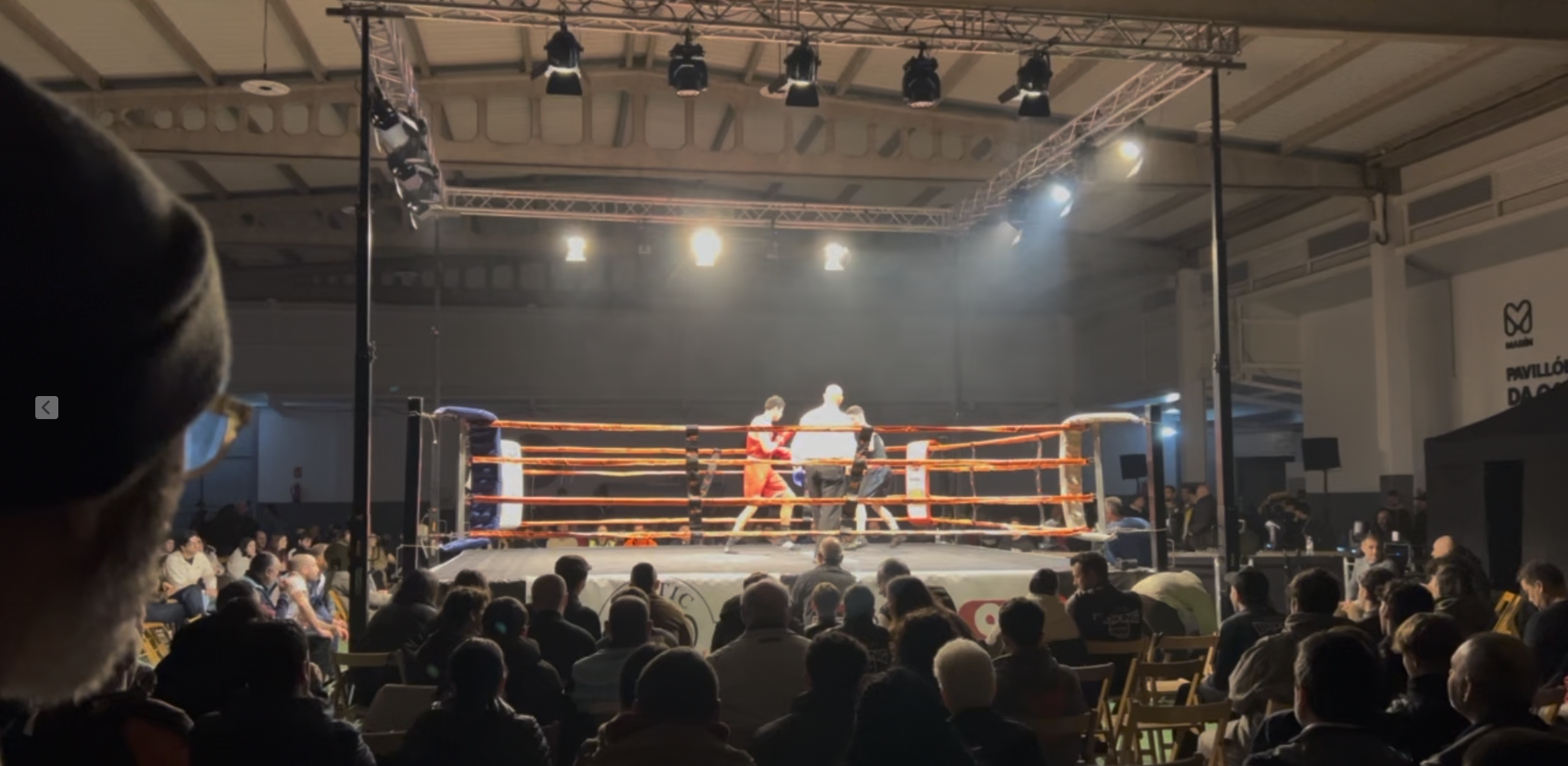
I'd talked to him about going back to boxing for months over the counter. Then a group of us went to watch him fight in Marín - a town in the region of Pontevedra. Standing in that crowd, watching the boxers with each other after the bout - the handshakes, the respect, the camaraderie that had nothing to do with winning - I was flashed back to Willesden Junction.
That feeling of being alive because I was out of my depth, always having to learn something genuinely hard. The repetition. The rhythm. The focus. It felt useful for ADHD in a way I couldn't explain - less like exercise, more like a second instrument I hadn't picked up yet.
I didn't decide to go back to boxing in Marín. I just realised I already had.
The neighbourhood built the accountability system without being asked.
The VoiceNotes are the trunk. I didn't know I was writing it.
One of those tools is Littlebird. I mention it for one specific reason. It showed me that 14 hours had passed, when actually it had taken three to write this newsletter. And that after every call, without fail, I drift to YouTube. Every time. These are the patterns I need to train myself to see. Not fix. See. That is the whole practice: self-awareness, applied like a craft.
The acoustics of Epidaurus
I was in my twenties and my mother had died the year before.
My way of dealing with it was clubbing. My dad's way was the church. That summer, he invited me on a pilgrimage with their friends - Greece, sacred sites, the full circuit. The opposite of everything I was doing. I went.
On the bus through the Peloponnese, I stared at miles and miles of olive trees with my headphones in - a Sony MP3 player, this was 2002. Tillmann Uhrmacher, "On the Run" - Ministry of Sound Annual, Spring 2002. The song I'd been playing on repeat for months.
We stopped at the Theatre of Epidaurus.
It had been about a week - less a trip, more a transformational hug. A lot of the people there had been friends of my mother. It was good to spend that kind of time with them.
While everyone stood around talking, I put my headphones back in and ran. All the way up the stone steps to the top. Rocky-style. And up there: ancient ruins, a never-ending sky, the whole valley below, the air hanging green and still in all that space.
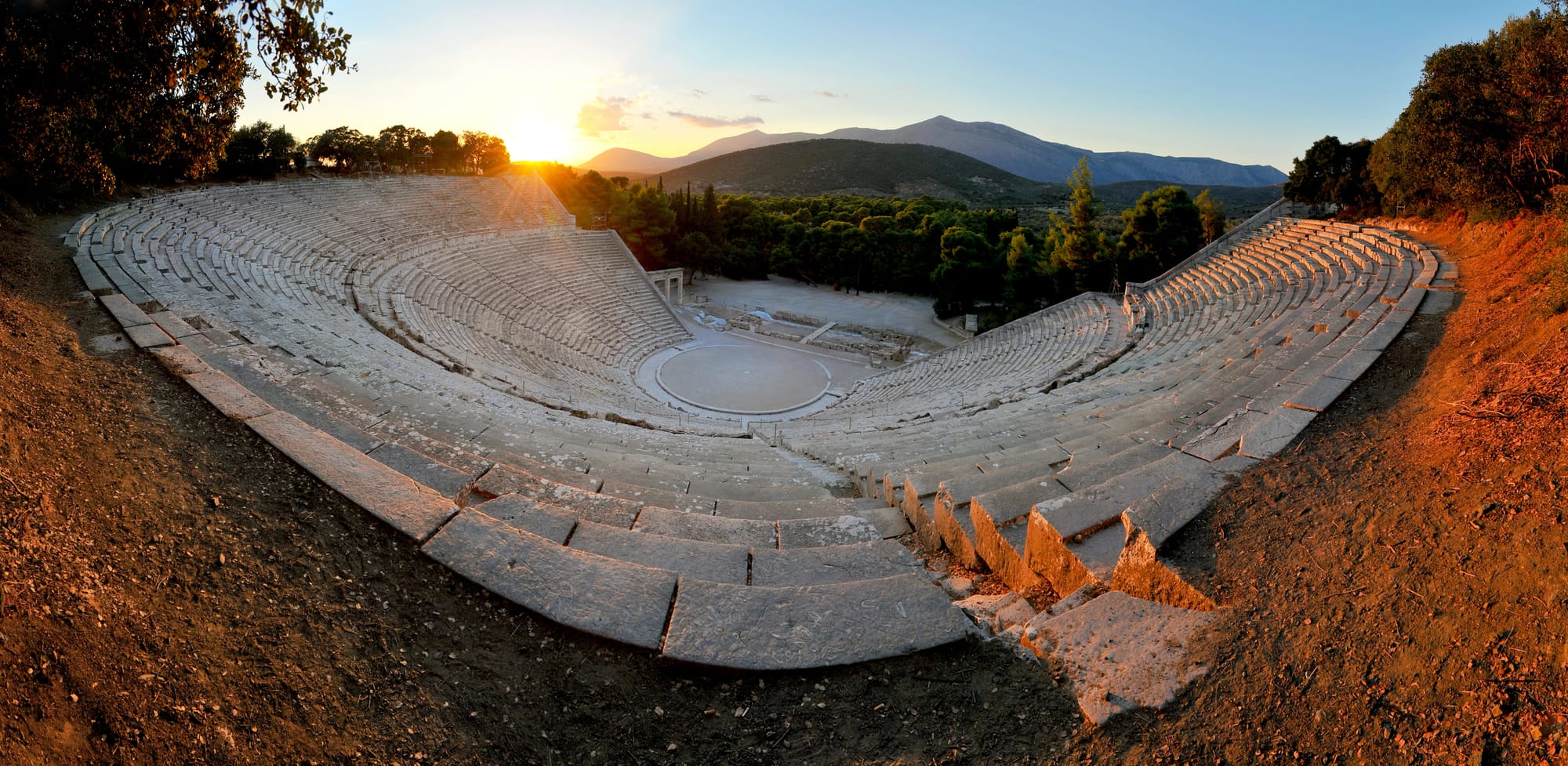
What I didn't know then is that Epidaurus was built on exactly one idea. The acoustics were designed so that every sound - every note, every whisper - reaches every seat. The ancient Greeks built a room that proved it in stone.
This week I was walking in Vigo, listening to a version of that same song, thinking about running - and a runner came from behind and bumped into me just as the lyric hit: I'm always running, always running, a runner.
Everything is connected
What Barenboim described was more specific than I'd realised. Each note, he said, depends on the note before it and the note after. Remove one and you don't just lose a sound. You lose the meaning of everything around it.
I've been saying this without knowing it for years.
They're on our frequency. This place has good vibes. We're in sync. We're resonating.
Every word we reach for when we talk about human connection - in community, in coworking, in any room where people are trying to build something together - is a sound word. We've been describing interdependence in musical terms this whole time.
We just hadn't named the composition.
The walk, the café, Jamie, the gym, the Boy, the newsletter. These aren't separate decisions. They're notes in a composition.
The consumer story treats every desk as an isolated note. Standalone. Replaceable. Interchangeable.
That's noise.
You've heard this a thousand times: "Coworking is more than desks and Wi-Fi." Nobody hears it anymore because the frame is still consumer. Still transactional.
Name it, depends on the note before it and the noteand you've stepped outside it. "Still in the consumer story."
The Monday Domino
Something's been waiting for you to come back to it. Maybe months. Maybe years. Maybe you've convinced yourself you can't anymore.
Name it. Then write down three of each:
Websites to visit - the resource, the community, the first door
Things you could pay for - the class, the kit, the subscription that makes it real
People you could phone - who already do, the thing you want to do
Emails you could send - who could help you take the first step
You don't have to do all of it this week. You just have to pick one thing before Monday's done.
That's the domino. What's yours?
⚡️ Bernie’s Picks
- The Lost Art of Running - Shane Benzie
- Everything Is Connected: The Power of Music - Daniel Barenboim
- Unreasonable Connection LIVE! - May 19, Space4, London
- How to Host an ACTionism Screening for European Coworking Day
Thank you for your time and attention today
Bernie 💚🍉
p.s. The next “in person” Unreasonable Connection is 19th of May, Space4.
Written by