
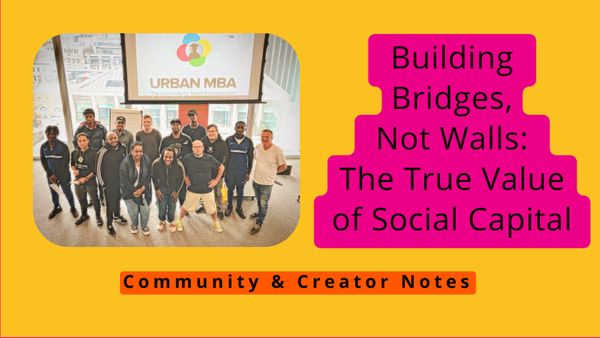
Building Bridges, Not Walls: The True Value of Social Capital
Community Doesn’t Happen by Accident—Here’s How to Build It With Intention.

So, reader, I had to start writing something about social capital and coworking, and the pile of sticky notes on my desk was out of control more than ever.
For a few weeks, I’ve been reflecting on a line I heard by comedian Josh Johnson that struck a chord:
"If you make your obsessions community, culture, connection, and compassion, then there is a way forward." - Josh Johnson
These aren’t just lofty ideals; they’re the bedrock of what builds resilient communities, thriving coworking spaces, and fulfilling lives.
At a time when society feels increasingly fragmented, the concept of social capital has never been more critical.
Let’s unpack why.
Stop Thinking About Social Capital - Start Doing
I can’t recall when I was not thinking about social capital and social value.
When I say thinking, I don’t mean sitting in the British Library or a grant-funded Nesta office writing white papers in between canapes and Prosecco.
I mean connecting the dots of the work I’ve seen so many of you do over the years and getting to a point where a busy coworking community builder can implement it.
Many of the guests on the Coworking Values Podcast are people working at a ground level, looking people in the eye and working out the connections to build social capital.
As you’ll see from the words below, the social capital conversation has always existed.
Still, as London's society, economy, and tech change rapidly, economic divisions have increased.
It is evident in how we people talk about coworking in London.
Some people understand coworking and hospitality as luxury and affluence, while others see them as inclusion and a way to make people feel seen.
These two lines from the Coworking Values Podcast guests give me hope: Jon Alexander's idea of ‘finding the others’ and Lauren Hug's encouragement that ‘there are more of us’.
When I Got The Call
Last year, Hannah from Arc Club called and said, ‘Bernie, you have got to meet my mate Tiiley!’ And she was right.
Tilley Harris, co-founder of Akou, and I started talking about social capital and coworking, and equally quickly, I was out of my depth.
We both believe that coworking spaces are pockets of untapped social capital—places where trust, relationships, and mutual support are built daily.
Then, in December, Andy Haldane* wrote in the Financial Times that ‘Malign neglect of social capital sowed the seeds of many of our largest problems’, and Tilley called me for a quick five-minute chat. Two hours later…
*(Sorry, Andy’s article is behind one of those paywall things.)
But here’s the challenge:
- How do we measure social capital?
- How do coworking operators understand the value of what they’re already doing and use that to strengthen their communities?
- Honestly, we don’t have all the answers yet.
But through the London Coworking Assembly, we’re determined to figure it out—because understanding social capital is essential for coworking, communities, businesses, and society.
That’s what led me to this article you are now reading.
What Is Social Capital, and Why Does It Matter?
Social capital refers to the networks, trust, and shared norms that enable cooperation and collaboration.
It’s the invisible glue that holds societies together.
When social capital is substantial, communities thrive: neighbours look out for one another, opportunities emerge through trusted networks, and collective action feels natural.
But when it weakens, as Robert Putnam famously documented in Bowling Alone, the effects ripple out—less civic engagement, diminished economic mobility, and more fragmented relationships.
Recent research shows how essential trust and collaboration are for societal and economic well-being.
Harvard economist Raj Chetty’s work demonstrates that strong social networks significantly enhance lifetime opportunities, particularly for disadvantaged groups. Countries with high levels of trust consistently outperform others in economic stability and growth.
Like hospitality, social capital isn’t a luxury; it’s a necessity.
So, how does this connect to coworking, creativity, and community building?
Stay with me!
Let’s explore.
Coworking as a Hub for Social Capital
Coworking spaces are microcosms of social capital in action.
These spaces do more than rent desks; they create opportunities for collaboration, trust-building, and shared purpose.
Take Mark Masters, a media entrepreneur who recognised the power of bringing people together.
He founded the "You Are The Media" Lunch Club, a monthly gathering in Bournemouth where individuals share meals and insights in a relaxed setting.
These informal lunches have become a cornerstone of his community, creating genuine connections and collaborations among attendees.
Mark has cultivated a vibrant network that thrives on shared experiences and mutual support by creating a space where people feel comfortable and valued.
This transformation wasn’t about fancy amenities or marketing campaigns. It was about creating rituals that build trust and deepen relationships.
After this came Creator Day - (I’m going for the first time this year!)
Coworking spaces are uniquely positioned to facilitate these connections, but the lessons apply far beyond coworking.
Social Capital Beyond Coworking
The need to build and sustain social capital isn’t exclusive to coworking operators.
It applies to anyone who leads, creates, guides, teaches or collaborates.
Genuine connection and trust fuel progress across industries, from education to creative fields to community-driven enterprises.
I studied education at Roehampton University in 2005, and the UK education system was already failing.
Even today, the UK education system still operates with an Industrial Revolution mindset.
Classes are run like factories, and students are taught to do low-grade clerical work and comply.
The value the government places on the teaching profession and schools is horrific.
Schools prioritise memorisation over application and testing over adaptability, leaving students unprepared for the contemporary landscape where relationships, networks, and real-world skills dictate success.
In his February 2006 TED Talk, Ken Robinson asked Do Schools Kill Creativity?
That talk has been viewed 23 million times on YouTube and over 78 million times on the TED website.
It still is the most watched TED talk of all time, but here we still are. 🤷🏻
1️⃣ Education & Social Capital: The Urban MBA Approach
That’s why alternative models like Urban MBA matter.
Instead of outdated instruction, it embeds students in real-world networks, mentorship, and professional environments.
A standout example was the Urban MBA course at 22 Bishopsgate, made possible through Caleb Parker and XCHG coworking.
In 2022, Urban MBA Students met twice weekly in this seventh-floor city coworking space for a year, bridging education and industry.
- Students engaged directly with professionals across various industries—connections they would never make in a typical college setting.
- The coworking space benefited as established professionals interacted with young creators and entrepreneurs, exchanging fresh perspectives.
- This reciprocal exchange built real social capital, expanding opportunities beyond classroom walls.
Get the Urban MBA White Paper by Kofi Oppong -
➡️ Education In The Fourth Industrial Revolution.
2️⃣ Writers & Creators: Building Social Capital Through Community
We’ve hosted the Creator Write Club in London coworking spaces for years—where writers share their work, receive feedback and build lasting connections.
Dan Koe calls social capital the new currency, emphasising that success no longer depends on traditional gatekeepers like publishers or corporate employers.
Creators cultivate trust, reputation, and opportunity by consistently showing up, sharing, and collaborating.
Investing in relationships through writing groups, creative networks, or digital communities allows those who invest in them to build leverage that fuels their careers.
3️⃣ Ali Kakande & Community Food Initiatives
Ali Kakande, founder of Caribbean Eats, turned the food into a tool for deep community connection.
What started as a lockdown meal delivery effort evolved into a canteen model, where people from all backgrounds gather, eat, and form genuine relationships.
These shared meals foster trust, break social barriers, and reinforce dignity, particularly for those who often feel unseen.
Ali’s work proves that something as simple as a shared meal can strengthen a community in ways that policies and institutions often fail to.
4️⃣ Farmers & Community-Supported Agriculture
Community-supported agriculture (CSA) operates on trust and shared investment. Members commit to farms before the harvest, ensuring sustainability for growers while receiving fresh, local food.
Research highlights that CSAs do more than provide produce.
They grow tight-knit communities by connecting people to their food sources, encouraging collaboration, and reinforcing the shared responsibility of local economies.
Social capital isn’t just about networking—it’s about strengthening relationships that sustain communities.
Taking Responsibility for Connection
In her book Let Them, Mel Robbins discusses the importance of letting people be who they are.
But there’s a flipside to that philosophy: taking responsibility for initiating connections.
Let them vs. let me.
Too often, we sit back and wait for others to reach out.
We assume someone else will host the event, make the introduction, or send the first email.
But building a community requires us to take the first step.
A coworking space owner doesn’t wait for members to connect magically; they create opportunities—a lunch, a workshop, a simple coffee chat—and make connections easy.
Likewise, leaders, creators, and even families can take small but meaningful actions to create a connection.
- Call someone you haven’t spoken to in a while.
- Invite a colleague to lunch.
- Start the book club you’ve been thinking about.
One of my favourite resources for working out how to do something is the book:
📚‘How To Begin’ by Michael Bungay Stanier
Unreasonable Connection: Skip the Panels, Build Real Relationships
🎪 Forget Big Conferences—This is the Smallest Coworking Event 🎪
Ditch the Infomercials, Invest in Real Connection
Most online and offline industry events broadcast instead of connect—panels, pitches, and keynotes where people leave with business cards, not relationships.
Unreasonable Connection flips that model - join our online event
⏰ 12th February 12 pm - 1 pm GMT 🇬🇧
A structured yet informal online gathering for coworking community builders—whether you run a space, support affordable workspaces or connect coworking with nonprofits, social housing, or childcare.
- No man-els. No sponsors. Just coworking community builders talking, sharing, and strengthening relationships.
- No hierarchy, no “sage on the stage”—everyone participates.
- Breakout groups spark honest conversations—not just polite small talk.
- It’s about finding like-minded people working on similar challenges.
- Trust is built through interaction, not passive listening.
Instead of another industry event filled with infomercials disguised as content, invest your time in spaces prioritising meaningful conversations and genuine community.
Coworking builders gather here—but the truth is universal: social capital thrives on real interactions, not transactions.
Practical Takeaways for Building Social Capital
If social capital is the glue that holds communities together, how can you actively cultivate it in your own life and work? Here are three ways to start:
Create Rituals That Foster Connection
Host a regular gathering, whether a community lunch, a weekly team check-in, or a neighbourhood potluck. Small, consistent rituals build trust over time.
Take the First Step
Don’t wait for others to reach out. Make the call, send the email, or extend the invitation. Initiating connections shows leadership and builds momentum.
Invest in Spaces That Bring People Together
Invest in environments that encourage collaboration and trust, whether it’s a coworking space, a library, or even a local café.
Building Social Capital Is an Infinite Game
James P. Carse, in Finite and Infinite Games, explains that finite games are played to win, while infinite games are played to keep the game going.
Building social capital is an infinite game. It’s not about quick wins or short-term gains. It’s about sustaining trust, relationships, and community over the long term.
Coworking spaces, classrooms, charities, farms, and families thrive when they embrace this mindset.
The goal isn’t to “win” at connection—it’s to keep building bridges, building trust, and creating spaces where people can grow together.
One more thing
As Josh Johnson suggests, obsessing over community, culture, connection, and compassion creates a way forward.
It’s not always easy and rarely glamorous, but the impact is undeniable.
Whether you’re running a coworking space, teaching in a classroom, or simply looking to strengthen your networks, the principles of social capital apply.
The question is: What small step can you take this week to build trust, create connections, and contribute to something bigger than yourself?
Find the others. Take responsibility. Play the infinite game.
👉 RSVP for Unreasonable Connection - The Worlds Smallest Coworking Event
Written by